嗽
Character Story & Explanation
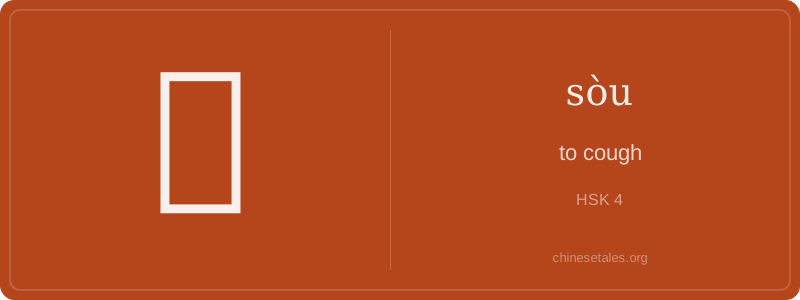
The earliest form of 嗽 appears in seal script (c. 3rd century BCE), where it combined 口 (mouth, sound) on the left with 叚 (jiǎ, an ancient variant of 假 meaning ‘borrow’ or ‘imitate’) on the right — but crucially, the right side evolved from a pictograph showing a person’s mouth open wide with a zigzag line representing turbulent breath. Over centuries, 叚 simplified into 爽 (shuǎng, ‘refreshing’) minus two strokes, then further condensed into the modern 又 + 口-like shape — resulting in today’s 14-stroke form: 口 + 隹 (but wait — no! It’s actually 口 + 爽 missing its top dots, visually resembling 又 + 丨 + 口).
This visual evolution mirrors semantic refinement: early texts like the Shuōwén Jiězì (121 CE) defined 嗽 as ‘a forced exhalation through the mouth due to lung disorder’. By the Song dynasty, it appeared in medical manuals describing ‘wind-cold invading the lungs’ — and poets like Su Shi used it metaphorically: ‘夜深人靜,唯聞數聲嗽’ (In midnight silence, only a few coughs were heard), evoking fragility and solitude. The character’s tight, angular strokes literally feel like a constricted throat — notice how the right side’s stacked horizontal lines mimic labored, staccato breathing.
Think of 嗽 (sòu) as Chinese’s onomatopoeic ‘cough button’ — it doesn’t just mean ‘to cough’; it *sounds* like a dry, raspy hack: the ‘sòu’ syllable mimics the sharp expulsion of air, much like how English uses ‘hack!’ or ‘achoo!’ But unlike English interjections, 嗽 is a full verb — it takes objects (e.g., 咳嗽), appears in aspect markers (咳嗽了, 咳嗽着), and even forms causative compounds (咳出一口血). You’ll rarely see it alone in speech — native speakers almost always say 咳嗽 (késòu), not just 嗽.
Grammatically, 嗽 is almost exclusively used in compound words or as the second character in reduplicated verbs (e.g., 咳嗽咳嗽). Using it solo — like saying ‘我嗽’ — sounds archaic or poetic (think Tang dynasty poetry), not conversational. Learners often overuse it standalone or misplace tones: ‘sōu’ (first tone) means ‘to scoop’, while ‘sòu’ (fourth tone) is the cough — one tone shift turns your throat into a ladle!
Culturally, persistent 咳嗽 signals more than illness — in traditional Chinese medicine, it reflects lung-qi imbalance, and elders may interpret a child’s frequent 嗽 as ‘excess heat’ or emotional suppression. Also, avoid writing 嗽 in formal health records — clinical contexts prefer 咳嗽 or medical terms like 支气管炎. And never confuse it with 溲 (sōu, to urinate) — that’s a very different kind of bodily function!