困
Character Story & Explanation
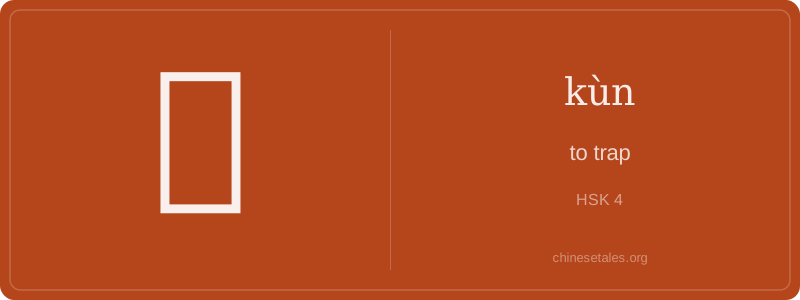
Carve this image into your mind: an oracle bone inscription from 3,000 years ago showing a kneeling figure (the ancient form of 木, later stylized) inside a square enclosure — the radical 囗 (wéi), meaning ‘enclosure’ or ‘boundary’. That tiny person wasn’t just sitting; they were *confined*, their limbs folded tight within walls. Over centuries, the kneeling figure simplified into the top component 木 (originally representing a person, not ‘tree’ — a classic case of shape repurposing!), while the enclosing square solidified into the unmistakable 囗 frame — seven strokes total: three for the square (top, left, right), then four for the inner 木.
This visual logic held firm through bronze inscriptions and seal script: confinement first, meaning second. By the Han dynasty, 困 already carried dual weight — physical entrapment (as in military sieges) and existential hardship (as in Mencius’ lament 困于陈蔡: ‘trapped between Chen and Cai’ during exile). The character didn’t just depict a cage; it became the ideographic shorthand for any condition where agency shrinks and pressure expands — a philosophical compression of human struggle into seven clean strokes.
At its heart, 困 isn’t just ‘to trap’ — it’s the visceral feeling of being *boxed in*: physically stuck, mentally exhausted, or socially constrained. The character radiates pressure and limitation, like walls closing in. Its core meaning evolved from literal enclosure (a person inside a boundary) to encompass exhaustion (body trapped by fatigue), difficulty (mind trapped by complexity), and even ‘hardship’ as a noun — all sharing that same suffocating sense of constraint.
Grammatically, 困 is wonderfully flexible: as a verb (e.g., 困住 ‘to trap’), an adjective (e.g., 困难 ‘difficult’), or even part of compound nouns like 困境 ‘predicament’. Learners often mistakenly use it alone as a transitive verb like ‘I困him’ — but native speakers almost never say that without a complement (e.g., 困住他 ‘trap him’) or in compounds. It’s rarely standalone in speech; context does heavy lifting.
Culturally, 困 carries quiet gravity — it appears in classical texts like the *Analects* (e.g., 困而不学, ‘in hardship yet not studying’), framing adversity as a moral test. A common learner trap? Confusing 困 (kùn) with 困 (kūn) — an archaic variant meaning ‘to sleep’, now obsolete except in poetic compounds like 困倦. Modern Mandarin uses 困 only for ‘trap/difficulty/exhaustion’, never ‘to sleep’ — so don’t nap your way into a grammar error!