围
Character Story & Explanation
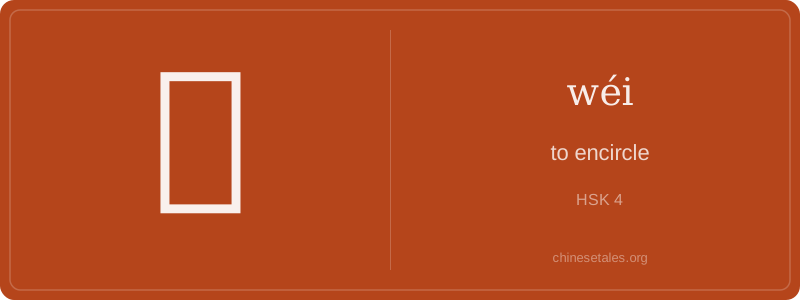
The earliest form of 围 appears in bronze inscriptions as a square enclosure (囗) with a simplified figure inside — sometimes a kneeling person, sometimes just a dot or stroke — symbolizing someone or something deliberately enclosed. Over time, the inner element evolved into the 'Wei' component (韦 wéi, originally meaning 'tanned leather', later borrowed for sound), giving us the modern structure: outer enclosure 囗 + inner phonetic 韦. Crucially, the enclosure wasn’t decorative — it was functional, like a moat or palisade drawn with ritual precision.
This visual logic shaped its semantic journey: from concrete military encirclement (e.g., in the Zuo Zhuan, 'the Jin army围 the city for seven days') to abstract containment ('encircling a problem' — 围绕 wéi rào). Even today, 围 retains its ancient tension between control and connection — you can 围住 an enemy, but also 围坐 around a table, where the same character turns threat into warmth.
At its heart, 围 (wéi) is about boundaries — not walls, but the dynamic, living act of surrounding: soldiers encircling a fortress, friends gathering around a hotpot, or even algorithms 'encircling' a solution. Visually, it’s built on the enclosure radical 囗 (wéi), which isn’t just ‘a box’ — it’s an active, intentional perimeter. Unlike static radicals like 口 (mouth), 囗 always implies agency and purpose: something *is being surrounded*, not merely contained.
Grammatically, 围 shines as a verb (e.g., 围住 wéi zhù — 'to surround and hold in place') and appears in common resultative complements like 围起来 (wéi qǐlái — 'to encircle so as to form a closed space'). Learners often misread 围 as passive ('surrounded') when it’s inherently active — the subject *does* the encircling. Also, avoid confusing it with 环 (huán, 'ring') — 围 emphasizes action and intent; 环 emphasizes shape or continuity.
Culturally, 围 carries strategic weight: from Sun Tzu’s art of war ('surround the enemy without fighting') to modern slang like 围观 (wéi guān, 'to spectate en masse'), where digital crowds 'encircle' online events — turning bystanders into participants through sheer presence. A classic mistake? Using 围 for 'wear' (that’s 戴 dàì!) — no one wants to 'encircle' their glasses!