址
Character Story & Explanation
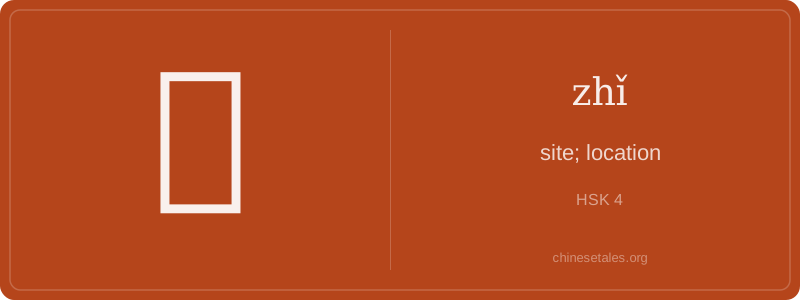
The earliest form of 址 appears in bronze inscriptions around 1000 BCE: a simple 土 (tǔ, 'earth') radical topped by a stylized 'foot' or 'step' (止, zhǐ) — not the modern 'shì' shape, but an early pictograph of a foot descending onto soil. This wasn’t abstract: it showed a person stepping down firmly onto land to claim or mark it — literally 'earth + step'. Over centuries, the foot glyph simplified and rotated, its horizontal strokes merging until, by the Han dynasty, it settled into today’s top component: a compact, three-stroke 'shì' that looks like a tiny roof or a folded flag — still echoing 'placement', but now purely symbolic.
By the time of the Shuōwén Jiězì (121 CE), Xu Shen defined 址 as 'the place where one stops and dwells' — emphasizing rest, settlement, and intentionality. It never meant 'any location'; it implied purposeful occupation: ancestral shrines had 祖址 (zǔzhǐ), temples had 寺址 (sìzhǐ). In Tang poetry, 址 appears rarely but pointedly — Du Fu used it once in a lament for fallen palaces: '宫阙尽成址' ('All palace gates became mere sites'), where 址 conveys haunting vacancy, not emptiness — the land remembers what stood there. That quiet gravity remains: 址 doesn’t just name space — it names history’s footprint.
Think of 址 (zhǐ) as Chinese cartography’s 'pin drop' — not the flashy marker on your phone map, but the quiet, authoritative dot that says: *this is where it began*. Unlike English 'site', which often implies construction or activity (e.g., 'building site'), 址 carries a sense of grounded permanence — it’s the earth itself holding memory. You’ll almost never use it alone; it’s a suffix, like '-ground' in 'battle-ground', always hitched to a modifier: 遗址 (yízhǐ, 'ruins site'), 校址 (xiàozhǐ, 'school location'). It’s not 'a place you go' — it’s 'the place that *is*', with historical or institutional weight.
Grammatically, 址 only appears in compound nouns — never as a verb, adjective, or standalone noun. Learners often mistakenly try to say 'I live at this site' using 址 directly (e.g., ×我在这个址), but it’s ungrammatical; instead, you’d say 我住在这个地址 (wǒ zhù zài zhè ge dìzhǐ, 'I live at this address') — note that 地址 (dìzhǐ) uses 址 *only* in the compound, and means 'address', not 'site'. The key is recognizing 址 as a fossilized morpheme: silent on its own, powerful in partnership.
Culturally, 址 whispers archaeology and legitimacy — it appears in official documents, heritage signage, and urban planning. A common slip is confusing it with 指 (zhǐ, 'to point'), especially in handwriting, because both sound identical and share the 'zhǐ' pronunciation. But while 指 directs your finger, 址 anchors your feet. Misplacing them turns 'archaeological site' (遗址) into 'archaeological pointing' — a very confused excavation crew.