基
Character Story & Explanation
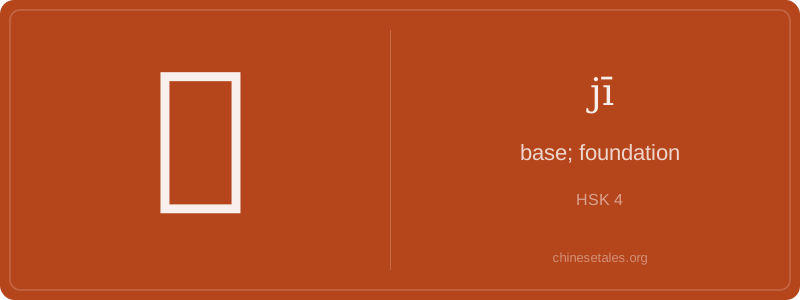
The earliest form of 基 appears in Western Zhou bronze inscriptions as a pictograph showing a mound of earth (the 土 radical at bottom) with two horizontal strokes above—representing layers of compacted soil laid down deliberately for stability. Over centuries, the top evolved from simple lines into the distinctive '其' component (qí), which originally depicted a basket used to carry and tamp earth—a tool essential for laying foundations. The modern 11-stroke structure preserves that ancient logic: 土 (earth/ground) + 其 (tool for preparing earth) = the act and result of establishing a solid base.
This practical origin seeded profound philosophical resonance. In the Book of Rites, the phrase '君子务本,本立而道生' ('The noble person focuses on the root; when the root is established, the Way arises') echoes 基’s meaning—not as passive ground, but as actively cultivated groundwork. Confucius didn’t mean 'stand still on solid ground'; he meant 'lay your ethical foundations deliberately, layer by layer, like builders tamping soil.' Even today, when Chinese engineers refer to 地基 (dìjī, 'foundation pile'), they’re invoking that same 3,000-year-old image of human intention shaping raw earth into support.
Think of 基 (jī) as the Chinese equivalent of the word 'bedrock'—not just physical ground, but the invisible, non-negotiable layer everything else rests on. In English, we say 'foundation of democracy' or 'base salary'; in Chinese, it’s always 基础 (jīchǔ) or 基本 (jīběn). Unlike English 'base', which can be neutral or even negative ('base instincts'), 基 carries quiet authority: it implies legitimacy, necessity, and structural integrity—not optional scaffolding, but the poured concrete beneath the building.
Grammatically, 基 rarely stands alone—it’s almost always part of a compound. You’ll see it in noun phrases like 经济基础 (jīngjì jīchǔ, 'economic foundation') or as a prefix in adjectives like 基本原则 (jīběn yuánzé, 'fundamental principle'). Crucially, it never functions as a verb (unlike English 'to base something on...'), so learners who write *我基於这个理由* (a direct translation of 'I base this on...') are making a classic error—the correct phrase is 我基于这个理由 (based on), where 基于 is a fixed preposition, not a verb + 基.
Culturally, 基 reflects China’s deep-rooted emphasis on hierarchy and prerequisite conditions: you don’t jump to 'advanced' without mastering the 基础; you don’t debate policy without acknowledging the 基本国情 ('basic national conditions'). Learners often overuse it trying to sound formal—e.g., saying *基点* instead of the simpler 起点 ('starting point')—but 基点 implies a strategic, irreversible reference point (like a geopolitical 'baseline'), not just where you begin.