填
Character Story & Explanation
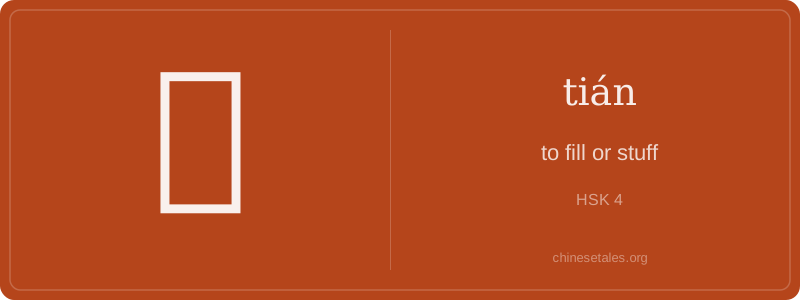
The earliest form of 填 appears in bronze inscriptions as a compound pictograph: on the left, 土 (tǔ, 'earth') — drawn as three horizontal lines representing layered soil — and on the right, 眞 (zhēn, later simplified to 真), which originally depicted a ritual vessel with a lid and contents inside, symbolizing 'authenticity' or 'fullness'. Over centuries, the right side morphed from 眞 to 真 to the modern 真, but its core idea — 'stuffing something genuine and complete into a space' — remained anchored to the earth radical. By the Han dynasty, the character stabilized into today’s 13-stroke structure: 土 + 真, visually echoing the act of tamping down earth to make it solid and level.
This earth-bound origin explains why 填 never means 'to occupy loosely' — it’s about density, weight, and finality. In the Book of Rites, 填 is used to describe filling ditches with compacted earth before building city walls — a labor-intensive, socially vital act. Even today, 填 retains that sense of purposeful completion: whether filling a form (a bureaucratic ritual) or filling a silence (a social one), it implies closing a gap with intention — no half-measures, no air pockets.
Think of 填 (tián) as Chinese’s version of a 'packing tape dispenser' — not the tool itself, but the *action* of pressing tape down firmly to seal gaps: deliberate, physical, and often requiring pressure or persistence. Unlike English 'fill', which can be passive ('the room filled with light'), 填 always implies *intentional insertion*: you’re actively stuffing, packing, or completing something with substance — soil into a trench, data into a form, or silence into an awkward pause.
Grammatically, 填 is almost always transitive and needs a direct object: you fill *something* — 填坑 (tián kēng, 'fill a pit'), 填表格 (tián biǎogé, 'fill out a form'). It rarely stands alone; even in commands, you’ll hear '把…填上!' ('Fill in the blank!') — note the 把 construction, which learners often omit, leading to unnatural speech like '*填表格*' instead of the more precise '*把表格填好*'. Also, it doesn’t pair with abstract nouns like 'hope' or 'love'; for those, you’d use 充满 (chōngmǎn), not 填.
Culturally, 填 carries quiet authority — it’s the character used when officials 'fill in' census records, engineers 'fill' embankments, or students 'fill' answer sheets under timed exams. A common mistake? Using it for 'filling time' (that’s 打发时间, dǎfa shíjiān). Also, beware tone: tián (2nd) is easily mispronounced as tiǎn (3rd), which means 'to lick' — imagine telling your boss you’ll 'lick the form' instead of 'fill it'!