增
Character Story & Explanation
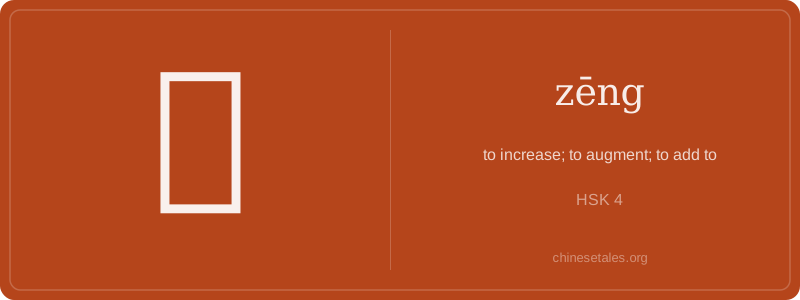
Carve this into your mind: the earliest form of 增 (in late Western Zhou bronze inscriptions) wasn’t about earth at all — it was a pictograph of a hand holding a measuring rod over a grain heap! The ‘earth’ radical (土) was added later to emphasize grounded, tangible growth — like crops rising from soil. Over centuries, the top simplified from a complex ‘hand + ruler’ shape into 曾 (zēng), a phonetic component that also meant ‘to layer’ or ‘to repeat’, reinforcing the idea of cumulative addition. The lower 土 stayed put — anchoring the concept in physical, earthly reality.
This evolution mirrors how Chinese thinkers viewed growth: not abstract or spiritual, but rooted in agriculture, administration, and measurement. In the Classic of Filial Piety, 增 appears in ‘增光宗族’ (enhancing family honor) — linking moral cultivation to visible, societal contribution. Even today, the character’s structure whispers its origin: 曾 (layer upon layer) + 土 (solid ground) = growth you can see, measure, and stand on.
At its heart, 增 (zēng) is about intentional, measurable growth — not just 'more', but 'added on purpose'. Think of stacking bricks: each addition is deliberate, visible, and builds upward. It’s never accidental or passive (unlike 多, which just means 'many'); it implies agency — someone increased something, often with effort or planning.
Grammatically, 增 is almost always a verb in modern Mandarin, appearing in compound verbs (e.g., 增加, 增强) or as the main verb in formal or written contexts. You’ll rarely hear it alone in casual speech — native speakers say 加多了 or 升了 instead — but it shines in reports, news headlines, and academic writing: 'GDP zēng le 5%' sounds precise and authoritative. Crucially, it’s transitive: you *increase something*, so it must take an object (e.g., 增加收入, not just 增加).
Culturally, 增 carries quiet optimism — it’s the character behind China’s ‘doubling GDP’ goals and ‘increasing green coverage’ policies. Learners often mistakenly use it like English ‘increase’ as an intransitive verb (e.g., *‘prices increase’ → *物价增), but that’s ungrammatical; you need 增长 or 上涨. Also, avoid confusing it with 累增 (cumulative increase) — 增 alone never implies accumulation unless compounded.