压
Character Story & Explanation
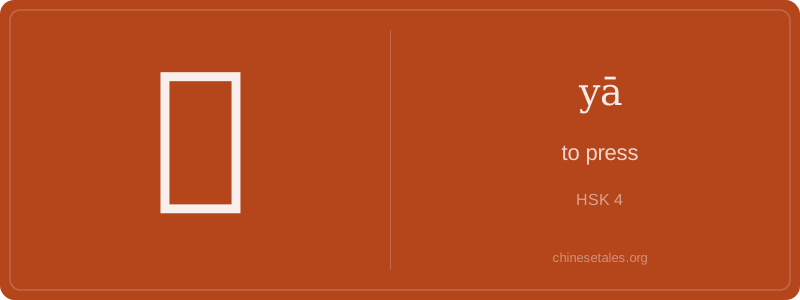
The earliest form of 压 appears in bronze inscriptions as a pictograph showing a hand (又) pressing down on a horizontal line representing an object — sometimes with a roof-like element above, hinting at containment. Over time, the hand evolved into the radical 厂 (hǎn), which originally depicted a cliff or overhanging rock — symbolizing something looming, sheltering, or exerting downward force. The lower part simplified from a complex ‘object under pressure’ to 又 (yòu, meaning ‘again’ or ‘hand’), then further stylized into the modern 又 — now purely phonetic but visually echoing action. By the seal script era, the six-stroke structure we know today was locked in: 厂 (the oppressive ‘overhang’) + 又 (the active ‘hand’ doing the pressing).
This visual logic shaped its semantic journey: from concrete physical compression (pressing grain in ancient mills) to abstract coercion (pressuring someone to comply). In the *Zuo Zhuan*, 压 appears in military contexts — ‘to press the enemy’s flank’. Later, in Tang poetry, it softened into poetic weight: ‘clouds压mountain ridges’. Crucially, the 厂 radical doesn’t mean ‘factory’ here (a modern homophone confusion!) — it’s the ancient ‘cliff’ glyph, silently reminding us that pressure often feels like a looming, inescapable presence overhead.
Think of 压 (yā) not just as 'to press' but as the feeling of weight bearing down — physically, emotionally, or socially. It’s a verb with gravity: you can压 a button (press),压 a book flat (flatten), or be压得喘不过气 (feel crushed by stress). Unlike English ‘press’, which often implies light, intentional action, 压 carries inherent force and resistance — something must yield. That’s why it rarely stands alone; it usually pairs with result complements like 住 (hold down), 下 (press down), or 碎 (crush to pieces).
Grammatically, it’s wonderfully flexible: it works as a transitive verb (她压着文件||Tā yā zhe wénjiàn — She’s holding the documents down), a causative in compound verbs (压抑情绪||yāyì qíngxù — suppress emotions), and even as a noun in set phrases like 高压 (gāoyā — high pressure). Watch out for tone sandhi traps: when followed by a fourth-tone syllable, yā sometimes shifts subtly in speech — but never in writing! Learners often overuse it for ‘press’ (e.g., pressing a key), where 按 (àn) is more natural.
Culturally, 压 reflects China’s nuanced relationship with constraint: 压力 (yālì — pressure) isn’t inherently negative — ‘healthy pressure’ drives excellence; yet 过度施压 (guòdù shī yā — excessive pressure) is widely criticized in education. And don’t miss the charming idiom 轻装上阵 (qīngzhuāng shàngzhèn — go into battle lightly equipped): literally ‘remove the pressure before charging’, it reveals how deeply this character lives in Chinese metaphors for resilience.