士
Character Story & Explanation
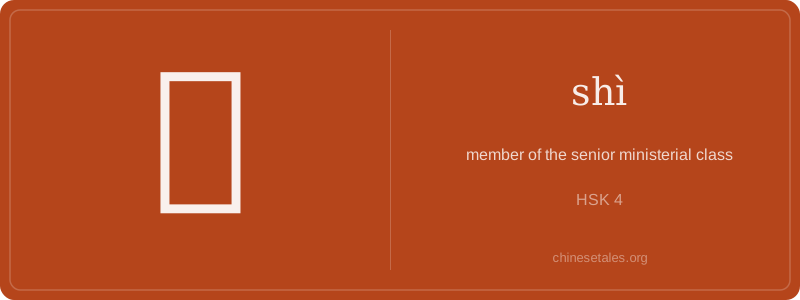
The earliest form of 士 appears in oracle bone inscriptions as a simple, upright figure with a broad head and two strong legs—resembling a dignified person standing at attention, arms folded or holding a ritual vessel. By the bronze script era, it evolved into three clean strokes: a horizontal top line (representing the ceremonial cap or headband), a long vertical stroke (the upright body), and a final horizontal base (symbolizing the stable stance or platform of authority). No extra flourishes—just disciplined minimalism. Its three-stroke simplicity wasn’t laziness; it was precision: every line earned its place.
This visual austerity mirrored its evolving role. In the Book of Rites, shì denoted the lowest rank of nobility—yet crucially, one who could read, write, and administer justice. Unlike hereditary lords, many shì rose through merit—a precursor to imperial examinations. Mencius wrote, 'Shì bù shí ér bù shí, bù yǐn ér bù yǐn' ('A true shì does not eat what he has not earned, nor drink what he has not merited'), linking the character’s clean lines to moral clarity. Even today, its unadorned shape whispers: integrity needs no decoration.
Imagine a quiet courtyard in ancient Luoyang, where a robed man stands calmly before the Duke—not as a soldier, not as a servant, but as a cultivated advisor: wise, upright, and entrusted with statecraft. That’s the shì: not just 'scholar' or 'gentleman', but a morally grounded elite whose authority came from virtue and learning, not birth alone. This character pulses with quiet dignity—it’s never casual, never slangy. You’ll find it in formal titles (e.g., zhànshì, 'warrior'), professional roles (yīshì, 'physician'), and moral concepts (shìqì, 'integrity').
Grammatically, 士 is almost always a noun, rarely used alone—almost always paired in compound words. Learners often mistakenly treat it like English 'man' and say *'wǒ shì yīgè shì'* ('I am a shì')—but that’s unnatural. Instead, you say wǒ shì yī míng yīshì ('I am a physician')—using the classifier míng and the full compound. It also appears in fixed classical phrases like shì wéi dài biǎo ('a representative of the scholarly class'), where omitting the compound would sound archaic or poetic.
Culturally, 士 carries Confucian weight: it implies self-cultivation, loyalty, and ethical responsibility—not just knowledge. Modern usage preserves this gravitas: calling someone shìrén ('intellectual') isn’t neutral—it subtly honors their moral standing. A common mistake? Over-translating as 'gentleman' and missing its bureaucratic-historical roots: in Zhou dynasty records, a shì was literally a low-ranking noble who served as both administrator and warrior—hence the character’s clean, balanced strokes suggesting both stability and readiness.