巧
Character Story & Explanation
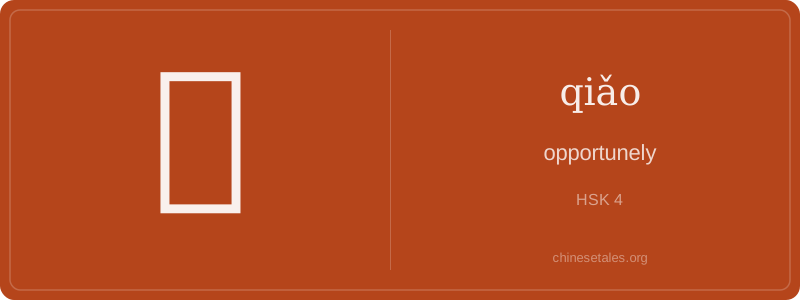
The earliest form of 巧 appears in Warring States bamboo slips — not as a pictograph, but as a *phonosemantic compound*. Its left side 工 (gōng, ‘craft, work’) is the semantic radical, anchoring it firmly in skilled labor. Its right side 丂 (kǎo, an archaic variant of 亏) served as the phonetic clue, hinting at pronunciation. Over time, 丂 simplified into the elegant, angular stroke we see today — five clean strokes total: horizontal, vertical, horizontal, downward-left, and upward-right hook — like a master carpenter’s chisel making one precise cut.
This visual economy reflects its meaning: maximum effect with minimum effort. By the Han dynasty, 巧 had expanded from ‘skilled in craft’ (e.g., a lacquerer’s fine brushwork) to ‘apt, timely, serendipitous’ — think of the *Zhuangzi*, where true skill is described as effortless alignment with the Dao. The character itself became a philosophical shorthand for *wu wei*-adjacent mastery: not forcing outcomes, but sensing and seizing the exact moment when action flows naturally.
At its heart, 巧 isn’t just ‘opportunely’ — it’s the spark of *elegant improvisation*: a craftsman threading silk through a needle’s eye at dawn, a diplomat deftly turning down an invitation without offense, or your friend slipping you the last dumpling when no one’s looking. The character pulses with quiet intelligence — not brute force, but *precision with grace*. Its core feeling is ‘skillful timing’, where ability meets moment.
Grammatically, 巧 rarely stands alone as an adverb in modern Mandarin; instead, it shines inside compounds like 巧合 (qiǎo hé, ‘coincidence’) or 巧妙 (qiǎo miào, ‘ingenious’). You’ll hear it in set phrases: 巧得很 (qiǎo de hěn) — literally ‘how巧!’ — meaning ‘What perfect timing!’ (often with warm irony). Learners mistakenly try to say *‘he did it qiao’* like ‘he did it well’ — but 巧 never modifies verbs directly that way. It’s a *relational* word: it describes how elements align — people, events, skills, moments.
Culturally, 巧 carries subtle moral weight. In classical texts like the *Analects*, Confucius warns against ‘巧言令色’ (qiǎo yán lìng sè — ‘clever speech and flattering looks’), hinting that excessive cleverness without sincerity can feel manipulative. So while 巧 celebrates ingenuity, it’s tempered by virtue — a nuance lost if you treat it as mere ‘cleverness’. Learners often overuse it where English would say ‘conveniently’ or ‘luckily’; in Chinese, those ideas lean on 恰好 (qià hǎo) or 真巧 (zhēn qiǎo), not bare 巧.