巾
Character Story & Explanation
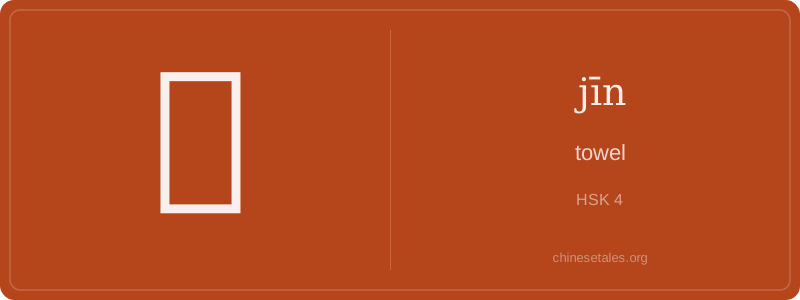
Carve this image into your mind: the earliest oracle bone script for 巾 looked like a simple rectangle with two short vertical lines dangling down — a literal pictograph of a cloth hanging from a line to dry. Over centuries, the dangling threads simplified into two downward strokes, while the top bar thickened and straightened; by the seal script era, it had settled into the clean, balanced three-stroke form we know: a horizontal top (representing the folded edge), a left vertical (the left side), and a right vertical (the right side) — no curves, no frills, just pure textile geometry.
This visual honesty endured. In the Shuō Wén Jiě Zì (121 CE), Xu Shen defined 巾 as ‘a piece of cloth used to cover the head or wipe the face’, confirming its dual domestic and ritual function. By the Tang dynasty, poets like Li Bai used 巾 metaphorically — ‘untying the official’s silk head-cloth’ signaled resignation from office. Even today, the character’s stark simplicity mirrors its enduring role: unadorned, practical, quietly essential — a silent witness to millennia of faces washed, heads covered, and tears dried.
At its core, 巾 (jīn) is a humble yet deeply visual character — it’s not just ‘towel’ but any rectangular cloth used for wiping, covering, or wrapping: bath towels, face cloths, ceremonial head coverings, even ancient military banners. Its meaning feels tactile and functional, evoking softness, absorbency, and purposeful drape — think of the gentle fold of fabric over your shoulder, not the stiff rigidity of paper or metal.
Grammatically, 巾 is almost always a noun, rarely used alone in modern speech — you’ll nearly always see it in compounds like 毛巾 (máo jīn, 'towel') or 红巾 (hóng jīn, 'red scarf'). It never functions as a verb or adjective, and crucially, it’s not interchangeable with 布 (bù, 'cloth') — 巾 implies specific size, shape (usually square/rectangular), and use (personal, hygienic, or symbolic). Learners often mistakenly say *yī gè jīn* ('one towel'), but native speakers prefer *yī tiáo jīn* (using the measure word 条, for long, flexible objects) — a subtle but telling detail about how Chinese perceives texture and form.
Culturally, 巾 carries quiet weight: in classical poetry, it symbolizes parting (e.g., ‘wiping tears with a silk handkerchief’), and in modern contexts, it appears in political imagery (红领巾 hóng lǐng jīn, 'Young Pioneer scarf') and hygiene education. A common error? Writing it as 干 (gān, 'dry') — same sound but zero relation — or misreading it as 巿 (fú, an obsolete variant of 市). Remember: this is cloth, not commerce or aridity.