弄
Character Story & Explanation
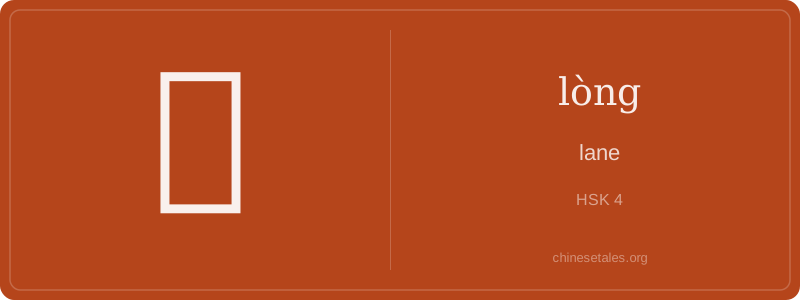
The earliest form of 弄 appears in bronze inscriptions as a hand (廾) holding a jade bi disc (a circular ritual object with a central hole). The original character depicted ceremonial handling — two hands cradling something precious and symbolic. Over centuries, the jade disc simplified into the top component (王), while the hands remained below as 廾 — giving us today’s 7-stroke structure: 王 + 廾. Though the modern shape no longer looks like hands clutching jade, the radical 廾 (gǒng, 'to hold with both hands') still anchors its etymology.
This ceremonial 'handling' gradually shifted semantically: from reverent manipulation of sacred objects → skilled management of things → and eventually, by the Tang and Song dynasties, came to denote narrow spaces where people 'handled' daily life closely together — lanes where households shared wells, walls, and responsibilities. In classical texts like the *Shuowen Jiezi*, 弄 was already noted for its dual life: as verb (nòng) meaning 'to play with' or 'to manage', and as a toponymic element (lòng) denoting confined, human-scaled thoroughfares — a beautiful semantic drift from ritual control to communal coexistence.
At first glance, 弄 (lòng) feels like a quiet, unassuming word — just 'lane' or 'alley,' the narrow passageways threading through old Shanghai lilong neighborhoods or Beijing hutongs. But its quietness is deceptive: it carries the hushed intimacy of communal life — where neighbors share steamed buns, gossip over laundry lines, and generations grow up within earshot of each other’s laughter and quarrels. This isn’t just geography; it’s social architecture made visible.
Grammatically, 弄 appears almost exclusively in place names and compound nouns — never as a verb in this pronunciation. Learners often mistakenly try to use it actively ('to lane' or 'to alley'), forgetting that nòng (with second tone) is the *verb* form meaning 'to handle, mess with, or fiddle with' — as in 弄坏了 (nòng huài le, 'broke it'). The two pronunciations are entirely separate lexical entries: lòng = noun (lane), nòng = verb (to tamper). Mixing them is like saying 'I alleyed the radio' instead of 'I messed with it.'
Culturally, 弄 evokes nostalgia for pre-modern urban rhythms — a world before wide boulevards and gated compounds. It’s embedded in iconic terms like 弄堂 (lòngtáng), which isn’t just 'alleyway' but a cultural microcosm: cramped, vibrant, interdependent. Foreigners sometimes misread 弄 as 'nong' (without tone marks) and pronounce it like 'long' — a small slip that flattens its gentle, rising-lane cadence. Remember: it’s *lòng*, like the soft hush when you step from a busy street into a shaded lane.