式
Character Story & Explanation
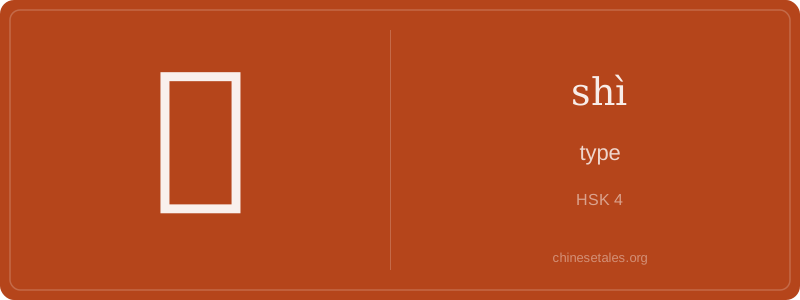
The earliest form of 式 appears in Western Zhou bronze inscriptions as a compound: a left-side component resembling a kneeling figure (later simplified to 工) and a right-side element depicting a halberd or marker pole (弋, yì — the radical we still see today). That pole wasn’t for war — it was a surveyor’s stake, planted in the ground to mark a fixed reference point, like a boundary stone or ritual axis. Over centuries, the kneeling figure morphed into 弋’s hook-like top, and the lower part condensed into 工 (gōng), representing measured, deliberate action — thus merging 'fixed marker' + 'regulated activity' into one glyph.
This visual logic drove its semantic evolution: from 'ritual marker' → 'prescribed ceremonial form' → 'standard pattern' → 'grammatical structure.' Confucius used 式 in the Analects (3.23) to praise Duke of Zhou’s 'perfectly modeled conduct' — not 'perfect behavior,' but 'behavior following the authoritative model.' Even today, the shape whispers its origin: the弋 radical (a vertical line with a tiny hook) is the stake in the ground; the 工 below is the leveled, squared-off foundation of any reliable system.
At its heart, 式 (shì) is about *patterned form* — not just 'type' in the abstract, but a standardized, repeatable, often ritualized structure. Think of it as the Chinese concept of 'template': a mold you pour meaning into. It’s not neutral like 英文中的 'kind'; it carries quiet authority — the 'way things are properly done.' You’ll see it in formal contexts: grammar patterns (句式), ceremony formats (仪式), even mathematical formulas (公式). Notice how it rarely stands alone? It almost always rides on another noun — never 'a shì,' but 'a *noun*-shì.'
Grammatically, 式 is a noun suffix, like English '-ism' or '-form.' It transforms verbs or nouns into 'the established way of doing X.' For example, 传统式 (chuán tǒng shì) means 'traditional-style,' not 'traditional type.' Learners often mistakenly use it where they need 类 (lèi, 'category') or 种 (zhǒng, 'kind') — saying '这种式' instead of '这种类型.' That’s like saying 'this kind-form' instead of 'this kind.' Also, don’t confuse it with 的 — 式 implies replicability; 的 implies possession or description.
Culturally, 式 echoes ancient Chinese reverence for order and precedent. In classical texts like the Rites of Zhou, 式 referred to prescribed ceremonial postures — not just 'how to bow,' but *the correct, sanctioned bow.* Today, that weight remains: using 式 subtly signals legitimacy. A startup might pitch its 'AI-driven decision-making 式,' implying it’s not just novel — it’s *institutionally sound.* Mistake it for 食 (shí, 'food')? You’ll accidentally order 'formula food' — an oddly nutritious blunder.