引
Character Story & Explanation
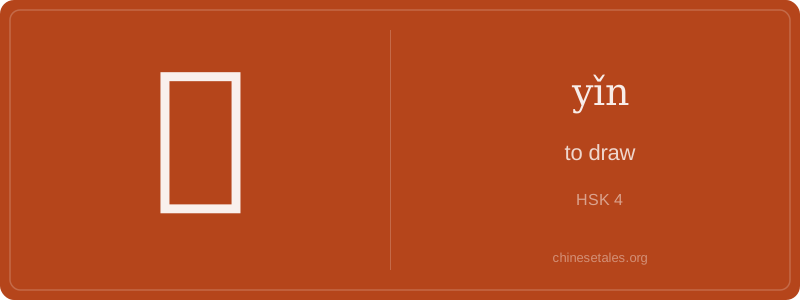
The earliest form of 引 in oracle bone script (c. 1200 BCE) looks like a bow (弓) with a line stretching horizontally from its center—like an arrow being drawn back along the string. That horizontal stroke evolved into today’s two diagonal strokes (the ‘丨’ and ‘丿’) flanking the bow radical. By the bronze script era, the shape had stabilized: 弓 on the left, and on the right, a simplified representation of the hand pulling the string—a single horizontal line becoming the top stroke (一), then the two diverging strokes mimicking tension and release. The four strokes aren’t arbitrary: they map the physical act—bow (radical), hand placement (top stroke), string recoil (left diagonal), and forward projection (right diagonal).
This visual logic shaped its semantic journey. In the *Analects*, Confucius says ‘夫子循循然善诱人’—‘The Master skillfully *draws people onward* (诱引)’—using 引 metaphorically for moral guidance. Over centuries, the ‘drawing’ meaning expanded from archery to intellectual influence (引经据典), causal relationships (引发事故), and even linguistic borrowing (引申义, ‘extended meaning’). Crucially, 引 never lost its core sense of *intentional, directional influence*—it’s the character of initiation, not reaction; of agency, not passivity.
Imagine you’re at a traditional archery range in Suzhou. An elder master nocks an arrow, draws the bowstring back with steady force—*yǐn*—and releases. That precise, controlled pulling motion is the soul of 引: not just ‘to draw’ like pulling a drawer, but to *draw toward*, *draw out*, or *draw attention*. It’s about intentional direction and influence—not brute force, but guided energy.
Grammatically, 引 is almost always transitive and pairs with objects that are abstract (引人注意, ‘to attract attention’) or concrete (引水入渠, ‘to divert water into a ditch’). Learners often mistakenly use it like English ‘pull’ with physical objects—‘I pulled the door’—but Chinese uses 拉 for doors; 引 is reserved for things like interest, resources, conclusions, or even historical events (引用典故, ‘to cite classical allusions’). Notice how it appears in verbs like 引导 (yǐndǎo, ‘to guide’) and 引起 (yǐnqǐ, ‘to trigger’)—always implying causation or invitation, never mere physical tugging.
Culturally, 引 carries scholarly weight: scholars ‘draw on’ (引用) ancient texts, leaders ‘draw forth’ (引发) public discussion, and poets ‘draw inspiration from’ (引自) nature. A common slip? Using 引 instead of 招 (zhāo) for ‘to invite’—‘引客’ sounds like ‘drawing customers like magnets’, but ‘招客’ is the natural phrase for ‘attracting patrons’. Also, 引 never stands alone as a verb in speech—it’s always part of a compound or followed by an object: you don’t say ‘He 引s’, you say ‘He 引起了注意’.