恐
Character Story & Explanation
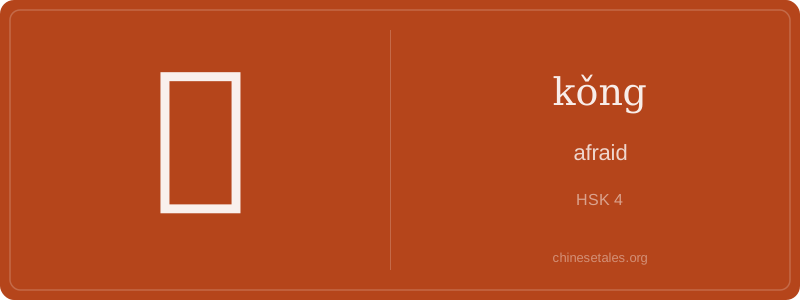
The earliest form of 恐, found on Shang dynasty oracle bones, was a vivid scene: a kneeling person (the top component, now written as 巩) with arms raised — not in surrender, but in startled recoil — above a heart (心). That heart wasn’t decorative: it anchored the emotion physically. Over centuries, the kneeling figure simplified into 巩 (gǒng, 'firm' — ironically, the very opposite of fear!), while the heart radical dropped to the bottom, solidifying the modern 10-stroke structure: 巩 + 心. The stroke order tells a story too — the three dots of 心 are written last, as if the fear settles deep only after the shock registers.
This visual logic shaped its semantic journey. In the *Zuo Zhuan*, 恐 described the dread of political betrayal — not panic, but the cold certainty of impending loss. By the Tang dynasty, poets like Du Fu used it for existential awe before nature’s power (*‘fēng yǔ rú huì, jī niǎo zhī kǒng’* — ‘when wind and rain rage, even birds tremble in fear’). Crucially, the 巩 component (meaning ‘to reinforce’) hints at an ancient insight: fear arises not from weakness, but from the mind’s urgent attempt to brace itself — a physiological truth modern neuroscience would later confirm.
At its heart, 恐 isn’t just ‘afraid’ — it’s the deep, visceral tremor before danger: the gut-clench when thunder cracks overhead or when you realize you’ve misread an official notice. Unlike the milder 害怕 (hài pà), which describes everyday unease, 恐 carries weight and urgency — often appearing in formal, written, or high-stakes contexts (e.g., news headlines, legal documents, or classical idioms). It rarely stands alone as a verb; instead, it thrives in compounds like 恐惧 (kǒng jù, 'fear') or as the root in verbs like 恐吓 (kǒng hè, 'to threaten').
Grammatically, learners often trip by trying to say ‘I am afraid’ with *wǒ kǒng* — but that’s unnatural. Native speakers say *wǒ hěn kǒngjù* or use the compound form. 恐 also appears in the passive-like construction 恐+verb (e.g., 恐难完成 — 'it is feared completion will be difficult'), a formal literary pattern common in reports and speeches. Notice how it’s almost never used in casual spoken Chinese — your friend won’t text ‘我恐’; they’ll say ‘我吓死了!’
Culturally, 恐 reflects how Chinese conceptualizes fear not as personal emotion alone, but as a socially resonant force — think of 恐怖分子 (kǒng bù fèn zǐ, 'terrorist'), where the character anchors gravity and systemic threat. A classic learner mistake? Confusing it with 空 (kōng, 'empty') — same sound family, totally different meaning and radical. Remember: 心 (heart) at the bottom means this fear lives in the body, not the air.