悉
Character Story & Explanation
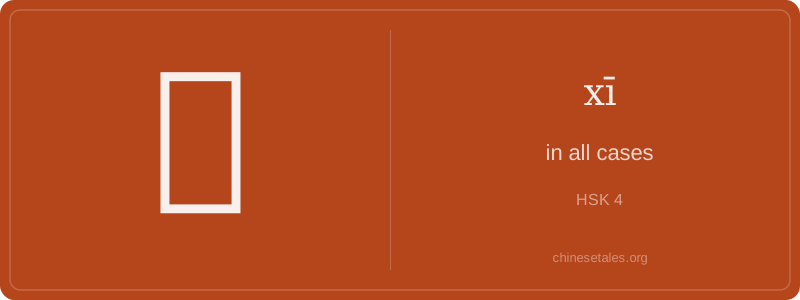
The earliest form of 悉 appears in bronze inscriptions as a compound: the top part was 米 (mǐ, rice grains), representing abundance or detail; the bottom was 心 (xīn, heart/mind), signaling cognition. Over time, 米 evolved into 釆 (biàn, ‘to distinguish by careful observation’ — originally a hand picking grain, then stylized into a cluster of dots and strokes), while the 心 radical stayed firmly at the bottom, anchoring the meaning in mental mastery. By the Han dynasty, the modern shape crystallized: 釆 above, 心 below — eleven strokes total, each one a subtle nod to discernment and inner clarity.
This visual logic shaped its meaning: not just ‘knowing’, but ‘knowing with full sensory and intellectual grasp’. In the *Zuo Zhuan*, 悉 describes rulers who ‘knew the people’s grievances in every village’; in Tang poetry, it evokes poets who ‘knew the seasons’ shifts in every leaf’. The character’s structure literally says: ‘mind that distinguishes every grain’ — a beautiful metaphor for precision thought. Even today, when scholars say 详悉 (xiáng xī), they echo that ancient ideal: knowledge that leaves no grain unexamined.
Imagine you’re a detective in ancient Chang’an, reviewing every single clue in a case — not just the obvious ones, but the dust on the floor, the ink smudge on the letter, even the servant’s nervous blink. That all-encompassing, meticulous attention? That’s 悉 (xī). It doesn’t mean ‘know’ like 知道 — it’s stronger, more thorough: ‘to know *in all cases*, down to the last detail’. It carries quiet authority and completeness — like a master herbalist who knows *every* property of every root, or a diplomat who grasps *all* unspoken tensions in a room.
Grammatically, 悉 is almost never used alone. It appears in formal written Chinese and set phrases — especially after verbs like ‘know’, ‘understand’, or ‘master’. You’ll see it in structures like 尽悉 (jìn xī, ‘fully understand’) or 初悉 (chū xī, ‘just learned’), always lending precision and gravity. Learners often mistakenly use it like a casual synonym for ‘know’ — but saying *‘Wǒ xī tā’* sounds as odd as saying ‘I thoroughly comprehend him’ in English dinner chat. It belongs in reports, letters, or solemn declarations — not WeChat texts.
Culturally, 悉 reflects the Confucian ideal of exhaustive understanding before action — think of the Analects’ emphasis on ‘knowing what you know and knowing what you don’t know’. Its rarity in speech (HSK 4 lists it because it appears in reading passages, not conversation) trips up learners who expect frequency. Also watch tone: xī (first tone), not xí (second) — confusing it with 席 or 习 changes everything. And remember: it’s always paired, never solo — like a scholar’s seal that only appears alongside official documents.