悔
Character Story & Explanation
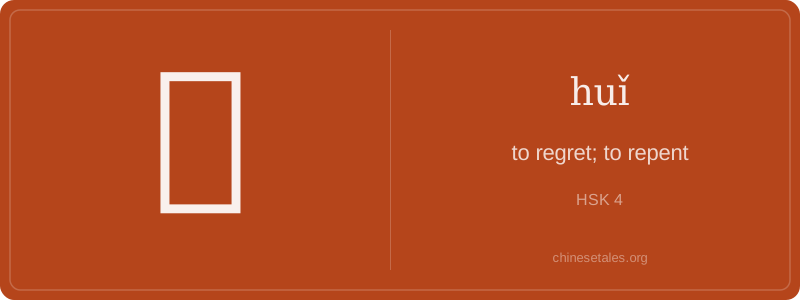
The earliest form of 悔 appears in bronze inscriptions around 1000 BCE — not as a pictograph, but as a phonosemantic compound already. Its left side, 忄 (the ‘heart-mind’ radical), was originally 心, drawn as a stylized heart with ventricles. The right side, 每 (měi), wasn’t chosen for meaning but sound — ancient pronunciations of 每 and 悔 were nearly identical. Over centuries, 心 shrank and shifted position to become the vertical 忄 on the left, while 每 retained its structure: a ‘mother’ (母) under a ‘grass’ (屮) roof — evoking nurturing, then later, repetition (‘each time’). By the Han dynasty, the modern 10-stroke form solidified: 忄 + 每 = ‘heart stirred each time’ — a brilliant visual echo of how regret returns, again and again.
This ‘recurring heart-stirring’ idea deepened in classical usage. In the Book of Rites, 悔 describes the sincere remorse of a scholar who fails ritual propriety — not guilt, but awakened self-awareness. Later, Chan Buddhist texts used 悔 in confession rituals (忏悔), pairing it with 忏 (chàn) to mean ‘acknowledging fault *and* resolving change’. Notice how 每’s ‘repetition’ root mirrors this: true 悔 isn’t a one-off sigh — it’s the heart returning, re-evaluating, learning. That’s why modern Chinese still says 后悔 (hòuhuǐ) — ‘after-coming regret’ — emphasizing timing and consequence, not just emotion.
At its heart, 悔 (huǐ) isn’t just ‘feeling bad’ — it’s the sharp, inward turn of conscience after a choice you *know* was wrong. Think of it as emotional accountability with teeth: it implies awareness, responsibility, and often a desire to make amends. Unlike English ‘regret’, which can be passive ('I regret the weather'), 悔 carries moral weight — you’re not sorry *things happened*, you’re sorry *you did them*. That’s why it almost always pairs with first-person subjects (我后悔了) or verbs indicating agency (他后悔辞职了).
Grammatically, 悔 is versatile but precise: as a verb, it’s intransitive and rarely takes a direct object — you don’t ‘regret *the thing*’; you ‘regret *doing* it’. So we say 我后悔没复习 (I regret *not studying*) — not 我后悔考试. It also appears in fixed patterns like 后悔+V/没+V, and as a noun in compounds like 后悔药 (‘regret medicine’ — a humorous idiom for something impossible, like a time machine). Learners often overuse it like English ‘sorry’, but 悔 is never polite filler — it’s emotionally heavy and contextually serious.
Culturally, 悔 sits at the crossroads of Confucian self-cultivation and Buddhist mindfulness: it’s not about wallowing, but about clear-eyed reflection that leads to change. A classic mistake? Using 悔 instead of 遗憾 (yíhàn) — which expresses gentle sorrow over uncontrollable circumstances (e.g., 遗憾不能参加 — ‘It’s a pity I can’t attend’). Mixing them signals a subtle but important cultural misstep: one is moral reckoning; the other is graceful acceptance.