惜
Character Story & Explanation
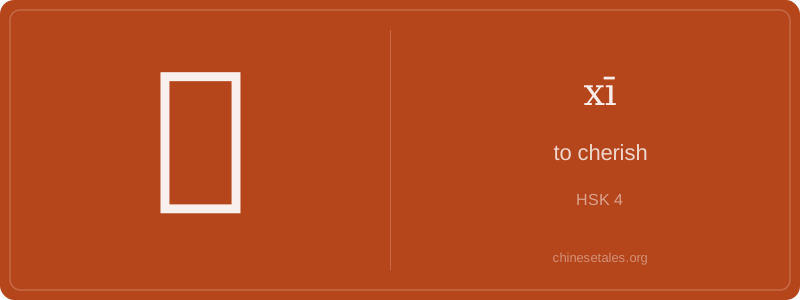
The earliest form of 惜 appears in bronze inscriptions as a combination of 心 (heart) and 昔 (xī, ‘past’), which itself originally depicted dried meat hanging to preserve — symbolizing ‘what was preserved from before’. In oracle bone script, 昔 resembled a sun (日) over layers — evoking ‘bygone days’. Over centuries, the heart radical (心) evolved into the left-side 忄 (‘heart-mind’), while 昔 stabilized as the right component, retaining its ‘past’ meaning and phonetic role. The full character thus visually whispers: ‘heart + past’ — feeling for what has been, or what might vanish.
This visual logic seeded its semantic evolution: from early texts like the Book of Songs, where 惜 described mourning lost virtue, to Tang poetry, where Li Bai used 惜花 (xī huā, ‘cherish flowers’) to express poignant awareness of beauty’s transience. By the Song dynasty, 惜 became central to Neo-Confucian ethics — valuing moral potential before it withers. Its shape never changed dramatically, but its emotional weight deepened: not just ‘regret’, but active, tender stewardship of what matters.
At its heart, 惜 (xī) isn’t just ‘to cherish’ — it’s the quiet ache of valuing something *before it’s gone*. Think of holding a fragile teacup you inherited, or watching autumn leaves fall: it carries gentle sorrow, respect, and conscious care all at once. Unlike 爱 (ài, 'to love') — broad and warm — or 喜欢 (xǐhuan, 'to like') — light and casual — 惜 implies emotional investment tinged with awareness of loss or scarcity.
Grammatically, 惜 is almost always transitive and appears in formal or literary contexts — rarely in casual speech. You’ll see it in compound verbs like 珍惜 (zhēnxī, 'to treasure'), or as the verb in structures like ‘惜 + noun’ (e.g., 惜时, ‘cherish time’) or ‘为…所惜’ (a classical passive: ‘is deeply regretted by…’). Learners often mistakenly use it like ‘miss’ (as in ‘I miss you’) — but that’s 想念 (xiǎngniàn). 惜 doesn’t mean longing; it means *protective regard*.
Culturally, 惜 reflects Confucian and Daoist values: respecting resources (惜物), honoring elders (惜老), even lamenting wasted talent (惜才). A classic mistake? Using 惜 alone as a standalone verb in spoken Mandarin — e.g., saying ‘我惜你’ sounds archaic or poetic, not natural. Instead, pair it: 我很珍惜你 (wǒ hěn zhēnxī nǐ). Also, note its tone: xī (first tone), not xí (second) — mispronouncing it risks sounding like ‘to wash’ (洗, xǐ)!