懒
Character Story & Explanation
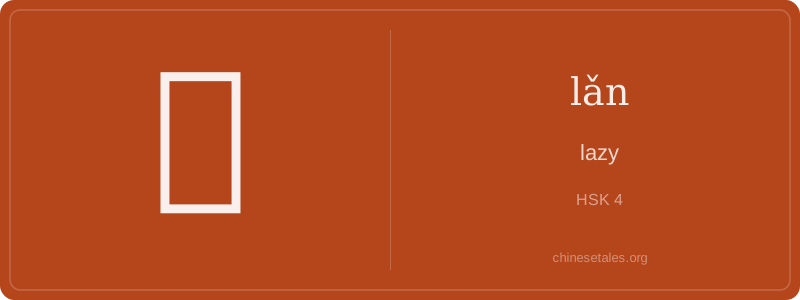
The earliest form of 懒 appears in Han dynasty clerical script — not oracle bone, since it’s a later semantic compound. Its left side 忄 (the ‘heart-mind’ radical) signals emotional/mental state, while the right side 嫩 (nèn, now obsolete as a standalone character) originally depicted ‘tender, soft, unresistant’ — think of pliant bamboo shoots. Over centuries, 嫩 simplified into the modern 叚 (jiǎ-like shape) + 夌 (líng, ‘to climb’), but crucially, the top part evolved into the distinctive ‘three horizontal strokes + dot’ that looks like drooping eyelids — visual shorthand for lethargy. Every stroke whispers ‘I don’t want to lift my head.’
By the Tang dynasty, 懒 was firmly entrenched in poetry and prose to describe moral laxity — Du Fu lamented officials who were ‘懒政’ (lǎn zhèng, ‘lazy governance’), linking personal inertia to societal failure. Interestingly, the character’s visual rhythm — slow, downward-leaning strokes — mirrors its meaning: the first three horizontals slump rightward, the final stroke drags low like a sigh. It’s rare for a Chinese character to so literally embody its definition through calligraphic gesture — making 懒 one of the most expressively drawn adjectives in the language.
At its core, 懒 (lǎn) isn’t just ‘lazy’ — it’s the visceral feeling of mental resistance: that heavy-limbed, ‘I’ll do it tomorrow’ slump we all know. The character radiates inertia, not idleness — it’s about unwillingness to exert effort, especially when duty or expectation looms. Unlike English ‘lazy’, which can be neutral or even playful (‘I’m lazy on Sundays’), 懒 often carries mild moral weight in Chinese, subtly echoing Confucian ideals of diligence (勤, qín) as virtue.
Grammatically, it’s an adjective that usually appears before nouns (懒人 lǎn rén — ‘a lazy person’) or after subjects with 是 (shì) or 很 (hěn): 他很懒 (Tā hěn lǎn). Crucially, it *cannot* directly modify verbs like English ‘lazy’ sometimes does (e.g., ‘lazy eating’). Learners often wrongly say *懒吃* — no! Instead, use structures like 懒得吃 (lǎn de chī — ‘too lazy to eat’) — where 懒得 is a fixed verbal phrase meaning ‘not willing to bother’. This 得 construction is non-negotiable and trips up even advanced learners.
Culturally, calling someone 懒 is rarely light teasing — it’s a gentle but pointed critique, especially toward students or young adults expected to strive. You’ll hear parents sigh, ‘这孩子太懒了’ (Zhè háizi tài lǎn le), not as insult, but as concern. Also, note: 懒 is almost never used in formal writing — you’d choose 懈怠 (xièdài, ‘negligent’) or 不勤勉 (bù qínmiǎn, ‘not diligent’) instead. Its home is spoken language, self-deprecation, and warm-but-worried family talk.