怀
Character Story & Explanation
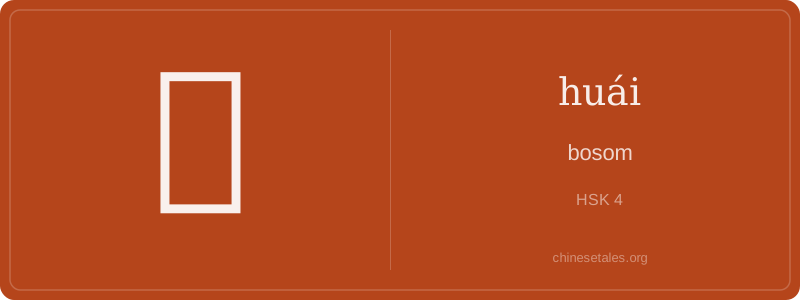
The earliest form of 怀 appears in bronze inscriptions as ⿰忄褱 — with 心 (heart) on the left and 褱 (a variant of 衣, 'clothing') on the right, depicting a person cradling something precious beneath their robe. Over time, the right side simplified from 褱 (13 strokes) to 十 + 目 + 衣’s lower part, eventually collapsing into 十 + 二 + 衣 → 怀. Visually, the modern 7-stroke 怀 still echoes that protective gesture: the radical 忄 (heart-mind) anchors the left, while the right side (十 + 二 + 一) subtly suggests arms wrapping around — two strokes for arms (十), two for hands (二), and a horizontal line (一) for the wrapped bundle or the hem of a robe.
This pictorial origin shaped its semantic journey: from literal 'holding under clothing' (Zhou dynasty ritual texts describing sacred objects carried thus), to 'holding in mind' (Warring States philosophy), then to emotional states — first reverence (《诗经》‘怀德’ — 'cherish virtue'), later nostalgia and suspicion. By the Tang dynasty, poets like Du Fu used 怀 in lines like '怀君属秋夜' ('Thinking of you on an autumn night'), cementing its role as the verb for sustained, inward-directed feeling. Its visual simplicity — only 7 strokes — belies how profoundly it encodes Chinese cultural values: emotion as containment, memory as tender custody.
Imagine holding a newborn baby close to your chest — not just physically, but with quiet awe, tenderness, and protectiveness. That warm, inward-facing space — the 'bosom' — is exactly where 怀 lives in Chinese consciousness. It’s not just anatomy; it’s emotional geography. 怀 carries the weight of intimacy, memory, and quiet longing: you don’t *hold* something in your bosom — you *embrace* it mentally or emotionally. That’s why 怀 almost never stands alone as a noun meaning 'bosom' in modern speech (you’d say 胸口 or 胸膛 for physical chest); instead, it thrives inside verbs like 怀念 (to miss), 怀疑 (to doubt), or 怀抱 (to hold in arms or harbor a hope).
Grammatically, 怀 is a verb root that always takes an object — and usually implies internal, sustained mental activity. You 怀念故乡 (miss your hometown), 怀疑他的动机 (doubt his motives), or 怀抱理想 (cherish an ideal). Crucially, it’s never used for fleeting thoughts: you wouldn’t say *怀想* for 'just thought of'; that’s 想起. Also, learners often misplace tones — huái (second tone) is easily confused with huài (fourth tone, 'bad') — a slip that turns 'I cherish this memory' into 'I ruin this memory'!
Culturally, 怀 evokes Confucian restraint: emotions held *within*, not shouted outward. In classical poetry, 怀 is the silent ache behind moonlit letters home. Modern usage preserves that hush — even 怀孕 (to be pregnant) literally means 'to hold a pregnancy in one’s bosom', underscoring care and concealment before birth. So when you see 怀, think less 'chest cavity' and more 'heart’s quiet chamber' — where feelings are gathered, sheltered, and deeply felt.