戴
Character Story & Explanation
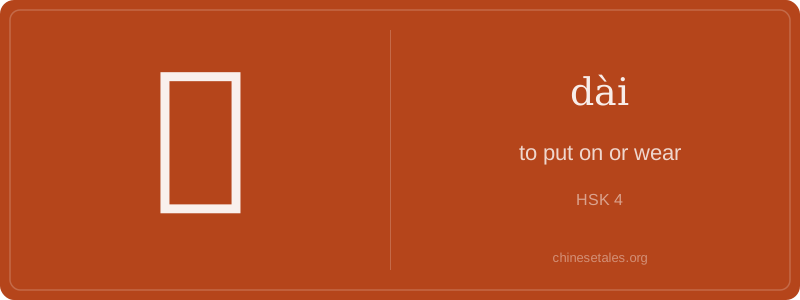
The earliest form of 戴 appears in bronze inscriptions as a complex pictograph: a person (人) with a prominent head, topped by a large, ornate headdress or ritual crown (the top part resembling today’s 异 or ), and a hand (又) actively placing it — all anchored by the radical 戈 (gē), originally a halberd but here serving phonetically and possibly suggesting solemnity or ceremony, like a weapon guarding ritual propriety. Over time, the headdress simplified into the upper component (a variant of 异), the person became 田 (a stylized head-and-shoulders shape), and the hand evolved into 共, while 戈 remained as both sound hint (dài sounds faintly like gē in archaic layers) and structural base.
By the Han dynasty, 戴 had solidified as the verb for ritually ‘bestowing’ or ‘assuming’ insignia — Confucius praised rulers who ‘wore benevolence’ (戴仁), and the Classic of Poetry mentions nobles ‘wearing crowns’ (戴弁). Its meaning never shrank; instead, it expanded from elite ritual to everyday adornment, yet retained its core sense of *intentional placement upon the person* — a linguistic fossil of ancient ceremony now worn daily on our faces and fingers.
At its heart, 戴 (dài) isn’t just ‘to wear’ — it’s the deliberate, respectful act of *placing something on top of the head or body* with intention. Think: putting on glasses, a wedding ring, a ceremonial cap, or even metaphorically ‘wearing’ a title like ‘hero’. Unlike 穿 (chuān), which is for clothing that wraps around the body (shirts, pants), 戴 implies *adornment*, *accessorizing*, or *symbolic placement* — it’s about what sits *on* you, not *around* you.
Grammatically, 戴 is a transitive verb that almost always takes a direct object (what you’re wearing), and it commonly appears in simple SVO structure: Tā dài yǎnjìng. (She wears glasses.) It rarely stands alone — you won’t say ‘I wear’ without specifying *what*. Also, avoid using it for footwear (use 穿) or underwear (also 穿); confusing these triggers native-speaker cringes! Bonus tip: 戴 can be used figuratively — 戴高帽 (dài gāo mào, ‘to wear a tall hat’) means ‘to flatter someone excessively’, a vivid idiom rooted in imperial court satire.
Culturally, 戴 carries quiet dignity: in traditional rites, elders ‘wear’ mourning bands (戴孝), and scholars ‘wear’ virtue (戴德). Learners often overgeneralize it to all clothing — a classic HSK 4 pitfall. Remember: if it goes *over your head* (hat, glasses, earrings, mask, crown), it’s 戴. If it goes *on your torso or legs*, it’s probably 穿. That tiny semantic boundary holds centuries of embodied logic.