户
Character Story & Explanation
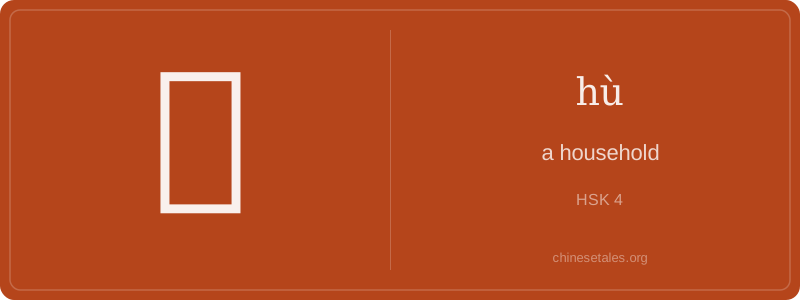
The earliest form of 户 appears in oracle bone inscriptions as a simple, elegant pictograph: a vertical line representing a doorframe, with a short diagonal stroke leaning inward—like a single door swinging shut. Over centuries, the diagonal became a curved hook (the top stroke), the frame thickened into two parallel strokes (the left vertical and lower horizontal), and the bottom ‘foot’ of the door evolved into the tiny dot-like stroke at the lower right. By the seal script era, it had stabilized into the four-stroke shape we use today—still unmistakably a door, but now stylized into something both functional and calligraphically balanced.
This visual origin directly shaped its meaning: in early texts like the *Zuo Zhuan*, 户 referred specifically to the main door of a noble residence—the threshold between public duty and private life. Gradually, the focus shifted from the physical door to the people behind it, giving rise to the core meaning 'household.' Confucian texts reinforced this by linking 户 to moral responsibility: a well-governed state begins with well-ordered households (修身齐家治国平天下). Even today, the character’s structure—enclosing space with minimal strokes—mirrors how a household creates social order through quiet, bounded unity.
Think of 户 (hù) not as a dry bureaucratic term like 'household'—but as the warm, slightly creaky wooden door to a family’s private world. In ancient China, this character literally pictured a single-leaf door opening inward; today, it still carries that sense of intimate, bounded belonging: one unit of people living under one roof, sharing one identity on official documents, one electricity meter, and often, one stubborn Wi-Fi password. It’s never used alone in speech—it’s always part of compounds like 用户 (user) or 农户 (farm household)—but its presence instantly signals 'a unit of human organization.'
Grammatically, 户 is a measure word for families or households—so you say 一户人家 (yī hù rénjiā), not *一户人*—and it also functions as a noun suffix marking types of households (e.g., 中产家庭 → 中产户). Crucially, it’s *not* a general word for 'door' (that’s 门 mén); learners often overextend it to mean 'entrance' or 'opening,' leading to unnatural phrases like *用户门* instead of 用户界面. Also, while 户 sounds like 'who' (谁 shéi), it has zero semantic link—don’t let the rhyme trick you!
Culturally, 户 embodies China’s millennia-old household registration system (hùkǒu), where your legal identity, school access, and even marriage eligibility hinge on your registered household. That’s why 'transferring your hukou' is a life-altering event—not just paperwork. Western learners often miss how emotionally charged this concept is: being 'without a household registration' (无户口 wú hùkǒu) means existing legally in limbo. So when you see 户, think less 'address' and more 'social anchor.'