扔
Character Story & Explanation
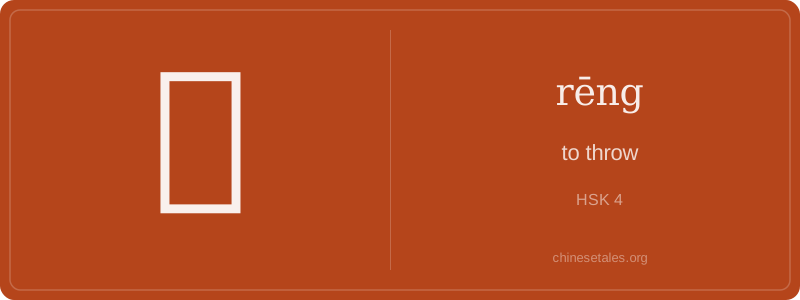
The earliest form of 扔 appears in Han dynasty clerical script, not oracle bones — because it’s a relatively late semantic-phonetic compound. Its left side 扌 (hand radical) clearly signals bodily action, while the right side 乃 (nǎi) was borrowed purely for sound (though 乃 originally meant ‘thus’ or ‘therefore’). Visually, imagine a hand gripping and releasing: the three horizontal strokes of 扌 are fingers clenching, then the diagonal stroke of 乃 mimics the arc of something flying outward — a brilliant stroke-level metaphor for release-in-motion.
By the Tang dynasty, 扔 had shed earlier synonyms like 拋 (pāo) in colloquial speech, becoming the go-to verb for informal, unceremonious projection. Classical texts rarely used it — it was too ‘vulgar’ for poetry — but vernacular novels like The Scholars (Rúlín Wàishǐ) embraced it for comic timing: ‘他一气之下把书扔在地上’ (Fuming, he threw the book on the ground). That visceral, almost cathartic energy — the visual snap of the final stroke slicing down like a tossed pebble — is why 扔 feels so alive in modern speech.
At its heart, 扔 (rēng) isn’t just ‘to throw’ — it’s the sharp, decisive *flick* of something you’re done with: a crumpled paper ball, an unwanted gift, or even a sarcastic remark. Unlike 投 (tóu, to hurl with aim) or 掷 (zhì, formal/ritual throwing), 扔 carries casualness, urgency, or even contempt — think tossing keys onto a counter, chucking trash into a bin, or ‘throwing’ a comment into a conversation. It’s almost always transitive: you *must* throw *something*. You can’t just ‘rēng’ into thin air — that would be like saying ‘I chucked!’ in English without an object.
Grammatically, it’s refreshingly straightforward: Subject + 扔 + Object (+ Location/Direction). But watch out! Learners often overuse it for polite actions — never say 扔 your coat on the chair; use 放 (fàng) instead. Also, avoid 扔 in formal writing; it’s conversational and slightly rough-edged. A classic error? Confusing 扔 with 仍 (réng, ‘still’), which sounds identical but shares no meaning — that slip could turn ‘I still love you’ into ‘I throw love you’!
Culturally, 扔 appears in vivid idioms like 扔掉面子 (rēng diào miànzi — ‘throw away face’, i.e., shamelessly abandon dignity) — revealing how physical action mirrors social risk. And yes, Chinese parents *do* scold kids with 扔了它!(‘Throw it away!’) when they dawdle — the character’s five strokes feel like a quick, impatient flick of the wrist.