抬
Character Story & Explanation
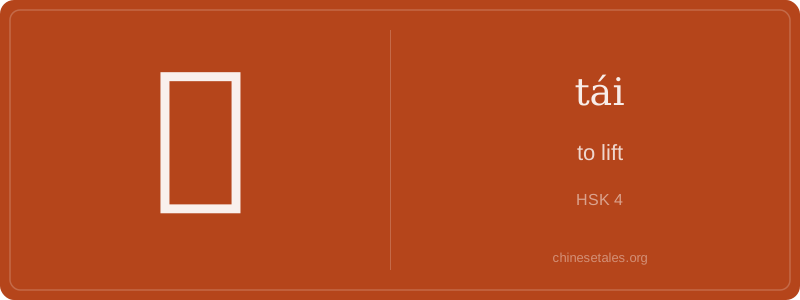
The earliest form of 抬 appears in bronze inscriptions as a combination of 手 (hand) on the left and 台 (tái, originally depicting a 'platform' or 'raised base' with a mouth-like element atop a stepped foundation). In oracle bone script, the 台 component resembled a tiered altar — emphasizing elevation. Over time, the hand radical evolved into the standardized 扌 (hand radical), while 台 simplified from its ancient multi-stroke altar shape into today’s clean 5-stroke form: 口 above 厶. The modern character thus visually spells out 'hand + raised platform' — a perfect pictorial recipe for 'lifting up'.
This concrete origin anchored its meaning across millennia: in the Classic of Poetry, 抬 described lifting sacrificial vessels; by the Tang dynasty, it appeared in Du Fu’s poems describing laborers lifting beams. Its semantic expansion followed the body outward — from lifting physical loads (抬轿, 'carry a sedan chair') to lifting eyes (抬头), voices (抬高声音), or status (抬举, 'promote someone'). Even today, the stroke order — starting with the hand radical, then building upward — mirrors the very motion it names: deliberate, upward, hands-in-motion.
Think of 抬 (tái) as the 'hands-on' verb for lifting — not just physically hoisting something, but raising your gaze, your voice, or even your social standing. It’s active, intentional, and almost always involves two hands (or at least the idea of coordinated effort). Unlike generic verbs like 拿 (ná, 'to hold') or 举 (jǔ, 'to raise' — more formal or ceremonial), 抬 feels grounded and practical: you lift a box, lift your head to see better, or lift a complaint to your boss.
Grammatically, it’s wonderfully flexible: it takes direct objects without particles (抬桌子, 'lift the table'), appears in resultative complements (抬起来, 'lift up'), and even forms idiomatic expressions like 抬杠 (tái gàng, 'to argue pointlessly' — literally 'lift a pole', evoking two people stubbornly hefting opposite ends). A common mistake? Using 抬 where 举 fits better — like saying *抬手* instead of 举手 ('raise hand' in class); 抬手 implies lifting the whole arm from the side, while 举手 is the crisp, upward gesture of volunteering.
Culturally, 抬 carries subtle weight: in traditional etiquette, 抬头 (tái tóu, 'lift head') signals respect and attentiveness, while 抬爱 (tái ài, 'lift one’s love') is a humble way to say 'your kind favor'. Learners often overuse it for abstract 'raising' — remember: 抬 is tactile, embodied, and slightly effortful. If you can feel the strain in your shoulders, you’re probably using 抬 correctly.