抱
Character Story & Explanation
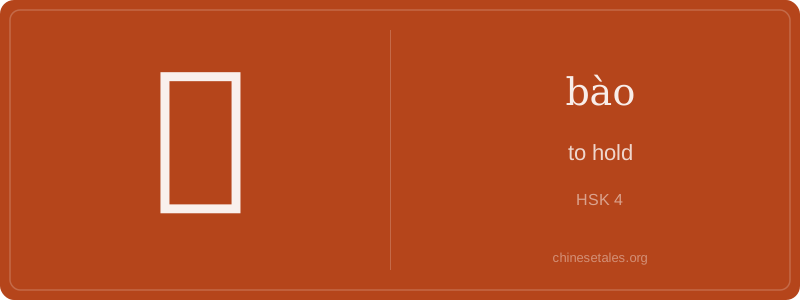
The earliest form of 抱 appears in bronze inscriptions around 1000 BCE as a hand (扌) reaching toward a child-like figure (包, which originally depicted a fetus wrapped in membranes). Over centuries, the child simplified into 包 — a 'wrapping' or 'enclosing' element — while the hand radical remained firmly on the left. By the Han dynasty, the structure solidified into today’s eight-stroke form: three strokes for 扌 (hand), then five for 包 (wrapping enclosure), visually echoing the act of arms wrapping around something small and precious.
This origin explains why 抱 always implies *active enclosure*: you don’t just touch — you surround. In the Book of Songs (Shījīng), 抱 appears in lines like '抱衾与裯' ('holding bedding and coverlets'), suggesting tender domestic care. Later, in Tang poetry, it evolved metaphorically: Du Fu wrote of 抱病 (bào bìng, 'holding illness' → 'being ill'), personifying sickness as something clutched unwillingly. The character’s visual logic — hand + wrap — never strayed from its core idea: intentional, embodied containment.
At its heart, 抱 (bào) is about intimate, deliberate physical containment — not just 'holding' like grabbing a cup, but cradling, hugging, or carrying something close with both arms and intention. Think of holding a newborn, hugging a friend after years apart, or clutching a precious object to your chest. It implies warmth, care, or sometimes urgency — you wouldn’t 抱 a rock unless it was heavy *and* meaningful.
Grammatically, 抱 is a transitive verb requiring a direct object (e.g., 抱孩子, 抱希望), and it often appears in compound verbs like 抱起 (bào qǐ, 'to lift up') or 抱住 (bào zhù, 'to hold tightly'). A common learner mistake? Using 抱 instead of 拥抱 (yōngbào) for formal 'hug' — while 抱 *can* mean 'to hug', it’s more literal and physical; 拥抱 adds emotional weight and formality. Also, never say 抱手机 — that sounds like you’re cradling your phone like a baby! Use 拿 (ná) or 握 (wò) instead.
Culturally, 抱 carries gentle authority: parents 抱 infants, elders 抱 hope for the future (抱希望), and even classical texts use it metaphorically — like 抱屈 (bào qū, 'to harbor injustice'), where emotion is literally 'held close'. This duality — tender physicality and internalized feeling — makes 抱 uniquely expressive in Chinese.