抽
Character Story & Explanation
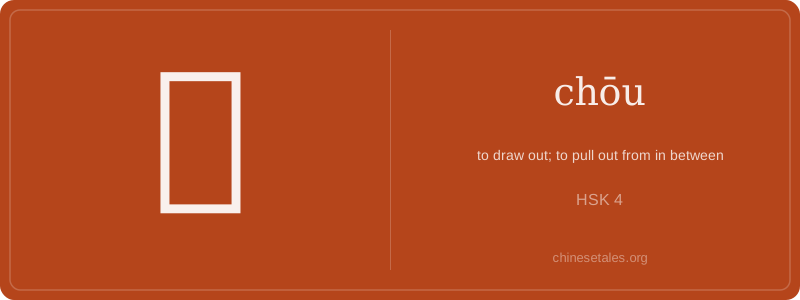
The earliest form of 抽 appears in Warring States bamboo slips as a compound: left side 手 (hand), right side 由 (yóu, originally a pictograph of a window or opening — later phonetic). The bronze script shows a hand reaching *into* a narrow vertical space — imagine fingers slipping between tightly packed bamboo slips to withdraw one. Over centuries, 手 simplified to 扌 (the ‘hand radical’), while 由 evolved from a window-like glyph into its modern box-with-a-vertical-stroke shape — retaining the idea of ‘a passage through a confined space.’ By the Han dynasty, the 8-stroke structure was stable: three strokes for 扌, five for 由.
This visual logic shaped its semantic journey: from concrete ‘withdraw a scroll from a case’ (as in early texts like the *Zuo Zhuan*) to abstract ‘extract essence’ (e.g., 抽象 in Neo-Confucian philosophy). The Tang poet Li Bai used 抽 in ‘抽刀断水水更流’ — drawing a sword to cut water, an image of futile yet striking effort — cementing its association with elegant, almost ritualistic removal. Even today, the stroke order reinforces meaning: you write the hand first (intent), then trace down 由’s vertical line (the path of extraction), making the act feel deliberate and linear.
Think of 抽 (chōu) as the ‘sneaky extraction’ character — it’s not just ‘pulling,’ but pulling *from within* or *out from between*: a cigarette from a pack, a drawer from a desk, a name from a hat, or even hope from despair. Its core feeling is *removal with effort and precision*, often implying something hidden, layered, or trapped. Unlike 拉 (lā, ‘pull’) or 拿 (ná, ‘take’), 抽 always suggests motion *outward* from confinement or interstitial space — you don’t 抽 a chair; you 抽 a drawer.
Grammatically, it’s wonderfully versatile: it works as a transitive verb (抽烟 chōu yān — ‘to smoke’), a separable verb (抽出来 chōu chū lái — ‘to pull out’), and even in abstract constructions like 抽象 (chōu xiàng — ‘abstract,’ literally ‘pull out form’). Learners often overuse it for simple ‘take’ — saying *我抽一本书* instead of *我拿一本书* — which sounds bizarrely mechanical, like extracting a book from a wall. Remember: 抽 implies resistance, layers, or concealment.
Culturally, 抽 carries subtle weight: 抽奖 (chōu jiǎng, ‘lottery draw’) evokes collective anticipation; 抽泣 (chōu qì, ‘sobbing’) mirrors the jerky, inward-outward rhythm of suppressed crying; and in classical usage, 抽刀 (chōu dāo, ‘draw sword’) signaled decisive, often dramatic action. A common slip? Writing 抽 with the wrong radical — forgetting the hand (扌) and using 日 or 目 instead. That turns ‘draw out’ into nonsense — so keep your hand on the handle!