扰
Character Story & Explanation
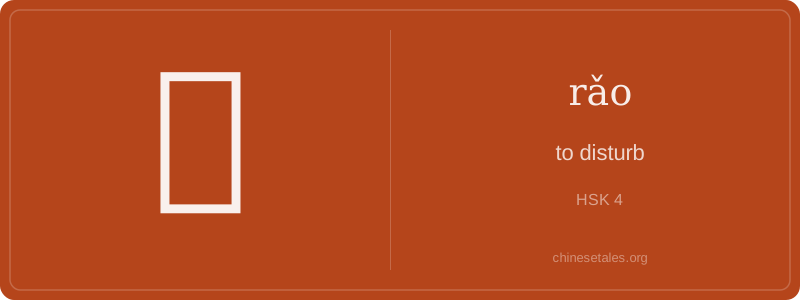
The earliest form of 扰 appears in bronze inscriptions as a compound: the left side was 扌 (hand radical), while the right was 尧 (yáo) — originally a pictograph of a person with exaggerated, waving arms and long hair, symbolizing agitation or unrestrained movement. Over time, 尧 simplified from a complex figure with head, arms, and legs into today’s seven-stroke form: the top two dots (丶丶), then the horizontal stroke (一), followed by the 'X' shape (乂), and finally the downward stroke (丿). The hand radical (扌) remained steadfast — literally grounding the idea of *a hand causing agitation*.
This visual logic held firm across millennia: in the *Zuo Zhuan* (c. 4th century BCE), 扰 described feudal lords ‘disturbing’ the Zhou king’s authority — not with violence, but with defiant ritual conduct. By the Tang dynasty, poets used 扰 to evoke wind disturbing water surfaces or thoughts disrupting meditation — always implying *external agency breaking inner or communal stillness*. Even today, the character’s structure whispers its meaning: three strokes on the right (丶丶一) look like falling leaves; the 乂 resembles crossed paths; the final 丿 is a sweeping hand motion — together, they animate the very act of disruption.
At its heart, 扰 (rǎo) isn’t just ‘to disturb’ — it’s the gentle but insistent nudge that breaks harmony: a cough in a silent library, a notification ping during deep work, or an uninvited opinion in a delicate conversation. In Chinese thought, where social equilibrium (hé 和) and quiet respect (jìng 敬) are deeply valued, 扰 carries subtle moral weight — it implies *unwelcome intrusion*, not neutral interruption. You wouldn’t say 扰 for a fire alarm (that’s necessary); you’d use it for your neighbor’s loud karaoke at midnight.
Grammatically, 扰 is almost always transitive and appears in formal or written contexts — rarely in casual speech (where people prefer 打扰 dǎrǎo or even softer phrases like 不好意思 bù hǎo yìsi). It commonly pairs with abstract nouns: 扰乱 (rǎoluàn, 'to disrupt'), 扰民 (rǎomín, 'to harass residents'), or as a verb in passive constructions: ‘被扰乱’ (bèi rǎoluàn, 'was disrupted'). Note: it’s *never* used reflexively ('I disturbed myself') — that’s a classic English-to-Chinese calque trap.
Culturally, 扰 reveals how Chinese prioritizes collective calm over individual expression — hence the bureaucratic phrase ‘不得随意扰民’ (bù dé suíyì rǎo mín, 'must not arbitrarily disturb residents'), often seen on community notices. Learners mistakenly use 扰 where English says 'bother' (e.g., 'Don’t bother me' → 不要打扰我, *not* 不要扰我), because 扰 lacks the mild, self-deprecating tone of 'bother'; it’s sharper, more accusatory. Think of it as the linguistic equivalent of stepping on a quiet rug — you feel the hush recoil.