支
Character Story & Explanation
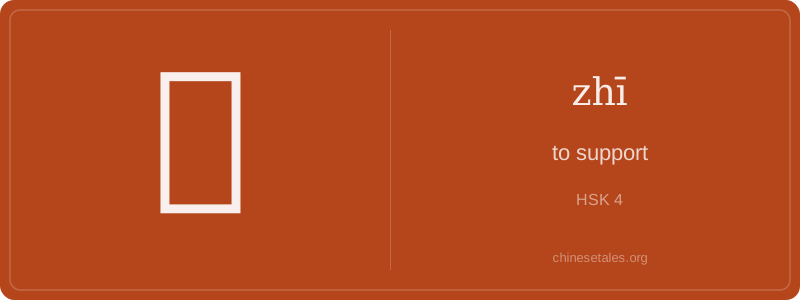
The earliest form of 支 appears in bronze inscriptions as a hand (又) gripping a long, upright pole or branch (十-like stem with a forked top). Over centuries, the hand simplified to the three-stroke 'branch' shape () on the left, while the vertical stem became the right-side stroke — evolving into today’s clean, four-stroke structure: + 丨. Notice how the top-left stroke angles down like a grasping thumb, the middle two strokes mimic fingers wrapping, and the final long stroke is the solid, unyielding pole being held aloft — pure visual grammar of applied force.
This image of a hand actively bracing a vertical object anchored its meaning: 'to prop up, to uphold.' In the *Analects*, Confucius praised those who could '支離其德' — literally 'prop up their virtue' — meaning to sustain moral integrity under pressure. Later, during the Tang dynasty, 支 expanded into financial contexts ('to disburse funds') because money, like a physical prop, enables action and stability. Even today, its shape whispers quiet strength: four strokes, no curves — all straight lines pushing upward.
At its heart, 支 (zhī) is about *upward force* — not just physical support, but the active, intentional act of propping something up, holding it steady, or enabling it to stand. Think less 'leaning against a wall' and more 'bracing a collapsing shelf with your hands.' That visceral sense of effortful, purposeful support is baked into every usage — whether you’re funding a project (资助), directing traffic (支使), or even just handing over cash (支付). It’s never passive; it always implies agency and direction.
Grammatically, 支 shines as a verb prefix in compound verbs like 支持 (to support), 支援 (to aid), and 支付 (to pay). Crucially, it almost never stands alone — unlike English 'support', you won’t say *'I 支 this idea'*; you must use the full compound. Learners often mistakenly treat it like a standalone verb or confuse its tone (zhī, not zhǐ or zhì). Also, watch out: when used in 支使 (to order someone around), it carries a subtle negative nuance — implying manipulation, not teamwork.
Culturally, 支 reflects China’s deep-rooted emphasis on relational scaffolding: families 支撑 (zhīchēng) each other, governments 支持 (zhīchí) key industries, and students are expected to 支持 (zhīchí) their teachers’ authority. The character subtly reinforces interdependence — no one stands alone; everyone is both supporter and supported. A common slip? Using 支 instead of 帮 (bāng) for simple 'help' — 支 is weightier, systemic, and structural.