收
Character Story & Explanation
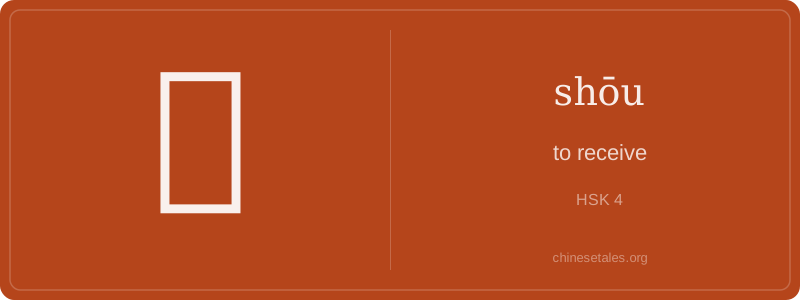
The earliest form of 收 appears in bronze inscriptions as a combination of ⺮ (bamboo — hinting at containers or stalks) and 又 (yòu, ‘hand’), later evolving to include 攵 (the ‘walk’ or ‘action’ radical) on the right. By the seal script era, it stabilized into today’s shape: a top part that looks like 矢 (shǐ, ‘arrow’) — actually a stylized grain stalk bending under weight — and the action radical 攵 on the right, symbolizing the hand gathering it in. The six strokes aren’t random: the first three sketch the drooping stalk; the last three (the ‘foot’-like 攵) show purposeful movement toward it — hands reaching, pulling, securing.
This visual logic anchored its meaning for millennia. In the *Book of Songs* (Shījīng), 收 describes harvesting millet; by the Han dynasty, it extended to collecting taxes (收赋 — shōu fù) and recruiting soldiers (收兵 — shōu bīng). Even Confucius used it metaphorically: ‘君子愛人以德,不以姑息’ implies moral ‘gathering’ — not indulgence, but disciplined care. The stroke order itself enacts the meaning: you start high (the stalk), then move decisively downward and rightward (the action radical), mirroring the motion of reaping — a perfect fusion of form, function, and philosophy.
At its heart, 收 (shōu) isn’t just ‘to receive’ — it’s about *drawing something in*, like gathering harvest into your arms or pulling a net tight. It carries an active, intentional sense of *acquiring and securing*: you don’t passively get mail — you 收信 (shōu xìn); you don’t just ‘have’ income — you 收入 (shōu rù). Notice how it almost always appears with a direct object: 收钱 (shōu qián), 收作业 (shōu zuò yè), 收快递 (shōu kuài dì). That’s non-negotiable grammar — unlike English ‘receive’, which can stand alone (‘I received’), Chinese requires what’s being received.
Grammatically, it’s wonderfully versatile: as a verb (收发票 — shōu fā piào), in resultative compounds (收好 — shōu hǎo, ‘put away properly’), and even as a noun in formal contexts (税收 — shuì shōu, ‘tax revenue’). Learners often overuse it for ‘get’ or ‘obtain’ where other verbs fit better — e.g., saying *shōu zhī chí* for ‘get support’ sounds stiff; 获得 (huò dé) or 得到 (dé dào) flow more naturally. Also, be careful: 收 is *not* used for ‘receiving’ abstract ideas — you don’t ‘receive’ advice; you 听取 (tīng qǔ) or 接受 (jiē shòu) it.
Culturally, 收 echoes China’s agrarian roots — the character literally began as a pictograph of hands gathering grain. That legacy lingers: we still say 收成 (shōu chéng) for ‘harvest yield’, and 收徒 (shōu tú) — ‘take on disciples’ — evokes a master drawing students into his fold. A common slip? Confusing it with 受 (shòu, ‘to suffer/undergo’) — mixing them up turns ‘I received the award’ into ‘I suffered the award’!