断
Character Story & Explanation
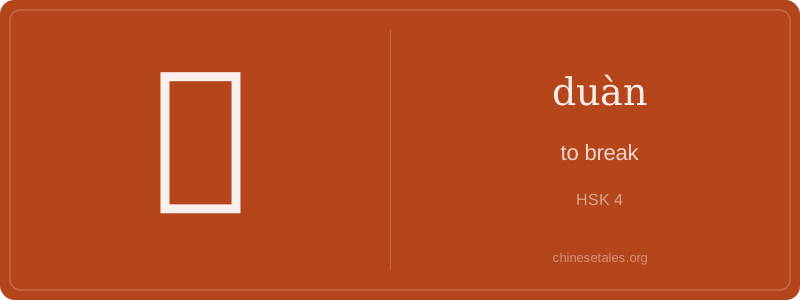
The earliest form of 断 (oracle bone script, c. 1200 BCE) shows two hands () gripping a log, with an axe (斤, the radical) poised to chop — a vivid, kinetic image of deliberate severance. Over centuries, the hands simplified into the top component 丨 and 丶 (representing force and impact), while the log evolved into the lower part 㡭 (a variant of 纟, suggesting a cord or bound thing), and the axe remained firmly anchored as the radical 斤 on the right. By the Han dynasty, the character stabilized into its modern 11-stroke form: a vertical stroke (丨) symbolizing the act of cutting down, two dots (丶丶) hinting at falling fragments, and 斤 — the unmistakable tool of decision.
This visual logic shaped its semantic journey: from physical chopping (in the Book of Documents: '断之以斧' — 'cut it with an axe') to metaphorical judgment (Mencius: '是非之心,智之端也;断之以理' — 'the heart that discerns right and wrong is the beginning of wisdom; one must judge by reason'). The axe didn’t just split wood — it split ambiguity. Even today, when judges '断案', they aren’t merely deciding — they’re wielding that ancient axe to cleave truth from falsehood, once and for all.
Think of 断 (duàn) as the Chinese equivalent of a clean, decisive snap — like breaking a dry twig with your fingers or cutting a rope with bolt cutters. It’s not messy tearing or slow erosion; it’s an intentional, irreversible separation: of objects, relationships, connections, or even time itself. Unlike English 'break', which can be accidental ('I broke the cup') or figurative ('break a habit'), 断 always implies agency and finality — someone *decides* to sever.
Grammatically, 断 is rarely used alone as a verb in modern speech; instead, it thrives in compounds (e.g., 断定, 断绝, 判断) or as the resultative complement after verbs like 切 (qiē, 'to cut') or 分 (fēn, 'to divide'): 他切断了电线 (tā qiē duàn le diàn xiàn — 'He cut through the wire'). Notice the structure: verb + 断 = completed, definitive separation. Learners often mistakenly use 断 where they need 结束 (jiéshù, 'to end') or 停止 (tíngzhǐ, 'to stop') — but 断 carries no sense of pause or suspension; it’s a hard stop, like snapping a pencil in half.
Culturally, 断 appears in weighty contexts: 断案 (duàn àn, 'to adjudicate a case') evokes imperial judges wielding authority to 'cut through' deception; 断交 (duàn jiāo, 'to sever ties') reflects Confucian seriousness about relationship boundaries. A common error? Using 断 for 'to break up' romantically without context — it sounds overly formal or harsh unless paired with words like 绝交 or 明确表示. Also, never say '我断了' alone — it’s incomplete; you must specify *what* was severed.