族
Character Story & Explanation
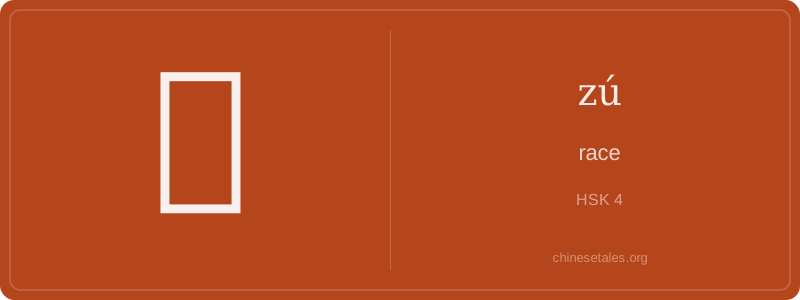
The earliest form of 族 appears on Shang dynasty oracle bones as a pictograph showing a banner (㫃, later simplified to 方) planted beside a group of people (often drawn as three stylized figures). That banner wasn’t decorative — it was a clan standard flown at ancestral altars or battlefields, marking territory and kinship. Over centuries, the ‘people’ element evolved into the right-hand component 乚 + 丶 + 一 (a stylized ‘arrow’ or ‘follower’ shape), while the banner became the left-side radical 方 — not because it means ‘square’, but because 方 originally depicted a ceremonial flagpole with fluttering fabric.
By the Warring States period, 族 had solidified as a term for ‘lineage group bound by ritual and shared surname’, appearing in texts like the *Zuo Zhuan*, where ‘灭族’ (miè zú) meant ‘eradicating an entire clan’ — not just killing people, but destroying their ancestral tablets and sacrificial rites. The visual logic remains intact: 方 (the banner/identity marker) + the clustered strokes (kinship ties) = a group defined by shared origin and enduring symbol. Even today, when you write those 11 strokes, you’re tracing the outline of an ancient flag waving over generations.
At its heart, 族 (zú) isn’t just ‘race’ — it’s about deep, inherited belonging: bloodlines, shared ancestry, and the unbreakable social unit that anchors identity in Chinese culture. Think less ‘biological category’ and more ‘clan you’re born into and carry forward’. That’s why it appears in words like 民族 (mín zú, ‘ethnic group’) and 家族 (jiā zú, ‘family lineage’) — always implying continuity, duty, and collective memory.
Grammatically, 族 is almost never used alone. It’s a bound morpheme — like English ‘-hood’ or ‘-dom’ — so you’ll always see it paired: as a suffix (e.g., 少数民族 shǎo shù mín zú, ‘ethnic minority’), or in compound nouns. Learners often mistakenly try to say *‘zú rén’ for ‘a person of a certain race’ — but that’s unnatural; instead, use 汉族人 (Hàn zú rén) or better yet, just 汉族 (Hàn zú). Also, note: 族 never means ‘individual race’ in isolation — it’s inherently plural and relational.
Culturally, 族 carries quiet weight. In imperial China, your 族 name (surname + clan affiliation) determined marriage eligibility, inheritance, and even legal responsibility. Today, saying ‘我们家族’ (wǒ men jiā zú) evokes generations of shared graves, ancestral tablets, and unwritten obligations — something no English word captures quite so densely. A common slip? Confusing it with 种 (zhǒng, ‘kind/species’) — but 种 is neutral taxonomy; 族 is warm, human, and loaded with history.