林
Character Story & Explanation
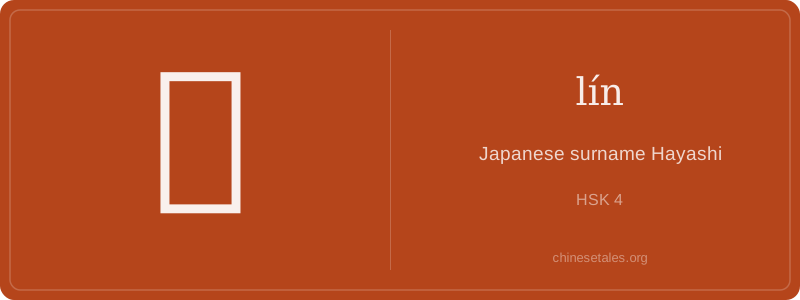
The earliest form of 林 appears in oracle bone inscriptions as two distinct 木 (mù) pictographs side-by-side — each a stylized tree with roots, trunk, and branching canopy. This wasn’t accidental duplication: it was deliberate doubling to signify ‘many trees’, a visual logic so intuitive it survived unchanged for over 3,000 years. As script evolved from oracle bone to bronze to seal to clerical, the two 木 elements gradually standardized into mirror-image symmetry, their strokes tightening but never merging — preserving that elegant duality. By the Han dynasty, the modern eight-stroke form was fully established: two identical 木 radicals sharing no stroke, standing shoulder-to-shoulder like twin sentinels.
This visual duality shaped its semantic journey. In the Shuō Wén Jiě Zì (121 CE), Xu Shen defined 林 as ‘a gathering of trees’ — emphasizing communal growth, not competition. Classical poets like Du Fu used 林 to evoke refuge and moral clarity (e.g., ‘竹林’ — bamboo grove — symbolizing scholarly integrity). Over time, 林 also absorbed metaphorical weight: in Daoist thought, a grove represents spontaneous order emerging from multiplicity — no single tree commands, yet harmony prevails. Its shape is its philosophy: strength in parallel, resilience in repetition.
At its heart, 林 (lín) is the quiet hum of many trees — not just one, but a collective presence. It evokes density, harmony, and natural abundance: think bamboo groves rustling in unison or ancient cypress forests where individual trunks blur into shared canopy. Unlike 木 (mù), which stands for a single tree or wood as material, 林 always implies plurality and organic coexistence — a subtle but profound reflection of Chinese worldview where relationships and context define meaning more than isolated entities.
Grammatically, 林 functions mostly as a noun (‘grove’, ‘forest’) or in compound words, rarely alone in modern speech. You’ll almost never say *‘I go to 林’* — instead, it appears in fixed phrases like 森林 (sēn lín, ‘forest’) or 林业 (lín yè, ‘forestry’). A common learner mistake is overgeneralizing it as a free-standing word meaning ‘forest’ — but native speakers instinctively reach for 森林 or 树林; 林 alone feels poetic, archaic, or surname-specific. It’s also the go-to component in surnames like 林 (Lín), echoing how nature-based clan names reflect ancestral ties to land and lineage.
Culturally, 林 carries quiet prestige: it’s among China’s top ten surnames, and its Japanese counterpart Hayashi literally means ‘edge of the forest’ — revealing how both cultures anchor identity in landscape. Learners often misread it as ‘wood’ (like 木) or confuse it with similar-looking characters (e.g., 琳), missing its essential plural, living quality. Remember: 林 isn’t timber — it’s trees breathing together.