染
Character Story & Explanation
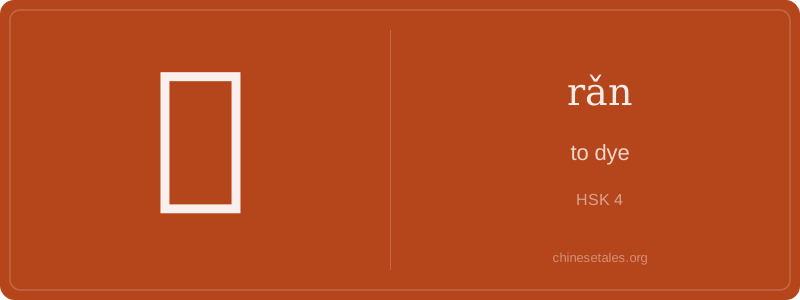
The earliest form of 染 appears in bronze inscriptions as a pictograph showing a hand (又) holding a brush or rod, dipping fabric (represented by a wavy line or cloth symbol) into a dye vat (the bottom part resembling a basin). Over time, the ‘cloth’ evolved into the radical 木 (wood), likely because early dyes were extracted from trees and plants — indigo from woad, red from madder root, yellow from pagoda tree bark — all wood-adjacent sources. The right side simplified from ‘冉’ (rǎn, meaning ‘gradually rising’) — suggesting slow, deep absorption — into today’s 九 + 丶, preserving both sound and the idea of gradual permeation.
This visual logic carried into meaning: by the Warring States period, 染 already described moral influence — Mencius wrote ‘君子之德,风也;小人之德,草也。草上之风必偃。’ (A gentleman’s virtue is like wind; a commoner’s like grass — the grass must bend before the wind), and later commentators said people ‘染于苍则苍,染于黄则黄’ (dyed in blue becomes blue, dyed in yellow becomes yellow), highlighting how environment colors character. Even today, 染 on social media means ‘being influenced’ — not just visually, but existentially.
Think of 染 (rǎn) as the Chinese equivalent of a textile artist dipping fabric into a vat of indigo — but with linguistic flair. At its core, it’s not just ‘to dye’ in the literal sense; it carries strong connotations of *irreversible change*, like ink bleeding into paper or gossip staining someone’s reputation. In Chinese, 染 is almost always transitive and action-oriented: you *染* something — hair, cloth, emotions, even abstract things like habits or ideology (e.g., 染上坏习惯). It rarely stands alone as a noun — unlike English ‘dye’, which can be both verb and noun — so learners who say ‘this is a 染’ are instantly flagged as non-native.
Grammatically, it loves the structure ‘染 + 上/了/成/为’ to signal completion or result: 染上了风寒 (‘caught a cold’ — literally ‘dye-ed onto wind-cold’), 染成了红色 (‘dyed into red’). Notice how 上 implies attachment, 了 signals change of state, and 成/为 emphasize transformation — each particle adds emotional texture. Also, 染 is often used metaphorically where English uses ‘catch’, ‘pick up’, or ‘be infected by’, making it far more versatile than its dictionary definition suggests.
Culturally, 染 evokes ancient silk-dyeing workshops in Suzhou and the deep symbolism of color in Chinese thought — red for luck, black for mourning, yellow for imperial authority. A common learner trap? Confusing it with 易 (yì, ‘easy’) due to similar top shapes, or misreading the right side as ‘九’ instead of ‘九’+‘丶’. Remember: 染 isn’t passive — it’s an act that leaves a mark, visible or invisible.