案
Character Story & Explanation
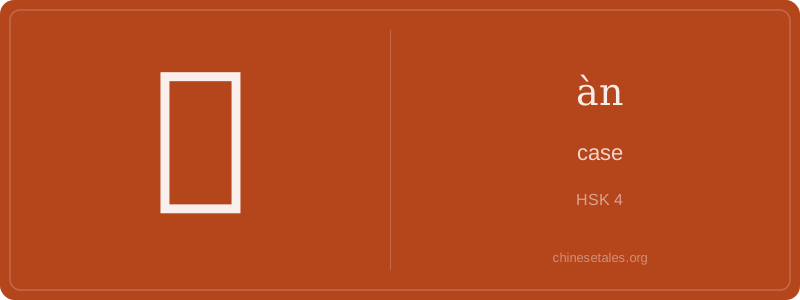
The earliest form of 案 appears in bronze inscriptions as a pictograph: a simple wooden table (木) with two short legs and a flat surface — sometimes with a scroll or object resting on top. The modern character preserves this essence: the left-side 木 radical signals its material origin (wood), while the right side 安 (ān) originally depicted a woman (宀 + 女) under shelter — implying safety, stability, and proper placement. Over centuries, the leg strokes simplified into the current 10-stroke structure: 木 + 安 = a stable, trustworthy surface for important things.
This visual logic shaped its meaning evolution: from physical table (Zhou dynasty texts like 《仪礼》 mention ritual offerings placed on the 案), to writing desk (Han dynasty scholars composed essays at their 案), then to 'matter laid before authorities' — i.e., a case. By the Tang dynasty, 案 was standard in bureaucratic documents, as in Du Fu’s poetry referencing 'cases piled high on the magistrate’s desk.' Its dual identity — furniture and formal matter — never split; instead, one reinforced the other: only what’s worthy of the table becomes a case.
Imagine you’re in a quiet, wood-paneled office in Beijing — not modern glass, but traditional: a low wooden table (案) sits in the center, covered with inkstones, scrolls, and a sealed document. This isn’t just furniture — it’s where decisions are made, contracts signed, and investigations launched. In Chinese, 案 carries that weight: it means 'case' — not as in legal briefcase, but as in *a matter under formal scrutiny*: a criminal case, an academic case study, or even a diplomatic incident. It’s never casual; it implies structure, evidence, and official attention.
Grammatically, 案 is almost always a noun and appears in compound words (like 刑事案件 or 案例), rarely alone. You won’t say 'I studied the àn' — you’ll say 'I read the case file' (查阅案卷) or 'this is a typical case' (这是一个典型案例). Learners often mistakenly use it like English 'case' in phrases like 'in case of rain' — but that’s 万一 or 如果, never 案. Also, don’t confuse it with 安 (ān, 'peace') — same sound, totally different universe.
Culturally, 案 evokes the Confucian ideal of orderly governance: every matter must be placed on the 'table' — examined, recorded, resolved. That’s why it appears in terms like 立案 (to formally open a case) and 结案 (to close a case): the table is both literal and metaphorical stage for justice. Even today, when police 'file a case', they literally 'set up the table' — a beautiful, enduring image of procedural integrity.