桶
Character Story & Explanation
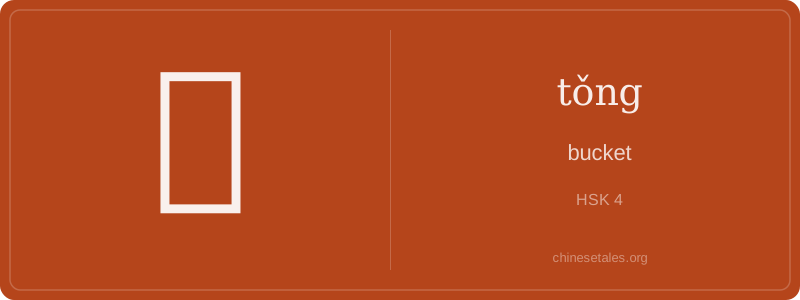
The earliest form of 桶 appears in Warring States bamboo texts as a vivid pictograph: two vertical lines (representing wooden staves) bound by three horizontal hoops — just like a real coopered barrel — with a rounded base and open top. Over centuries, the top simplified into 口 (kǒu, ‘mouth’), symbolizing the opening; the sides evolved into the left-side 木 (mù, ‘tree/wood’) radical, anchoring its material essence; and the right side solidified into 甬 (yǒng), originally a phonetic component meaning ‘passage’ or ‘pathway’ — hinting at the vessel’s function as a conduit for liquid. By the Han dynasty, the character had settled into its modern 11-stroke structure: 木 + 甬, visually echoing both craft and capacity.
This wasn’t just any container — in ancient China, 桶 denoted prestige and precision. The *Rites of Zhou* mentions royal granaries using standardized 桶 for tax grain, and Du Fu’s Tang poem ‘The Thatched Hut Destroyed by Autumn Winds’ laments rain leaking through the roof ‘into my single bucket’ — a stark image of humble containment amid chaos. Its shape — tall, upright, bounded — subtly reinforced Confucian ideals of measured restraint: a good 桶 holds what it must, nothing more, nothing less. Even now, saying ‘this plan fits in one bucket’ (这个计划装得进一个桶) jokingly implies it’s compact, self-contained, and eminently practical.
Think of 桶 (tǒng) as China’s original ‘Tupperware’ — not plastic, but hand-crafted wood, deeply practical, and quietly ubiquitous. Unlike English ‘bucket’, which often implies temporary or rough use (a bucket of sand, a bucket list), 桶 in Chinese carries a subtle weight of *containment with purpose*: it’s the vessel for water, oil, soy sauce, even data (as in ‘data bucket’ in tech jargon). It’s always countable (一桶水, yī tǒng shuǐ), and never used metaphorically without clear context — no ‘bucket of joy’ here!
Grammatically, 桶 is a measure word — but only for cylindrical, rigid containers holding liquids or granular substances. You say 一桶啤酒 (yī tǒng píjiǔ), not *一桶喝* — it never takes verbs directly. Learners often mistakenly use it like English ‘bucket’ in idioms (e.g., confusing ‘kick the bucket’ — which has no equivalent using 桶). Also, it’s never interchangeable with 杯 (bēi, cup) or 瓶 (píng, bottle): a 5-liter container of cooking oil is 一桶油, but if you pour some into a glass, it becomes 一杯油 — same substance, different measure word.
Culturally, 桶 evokes rural resilience and urban pragmatism alike: from well-drawn water in classical poetry to the ‘oil drum’ symbolism in modern environmental campaigns. A common slip? Writing 桶 as 桶 (correct) vs. 桶 with a mistaken 口 radical — but its 木 (wood) radical is non-negotiable: this was born from timber, not metal or clay. Even today, the best soy sauce still ages in wooden 桶 — a quiet nod to its grainy, grounded origin.