弃
Character Story & Explanation
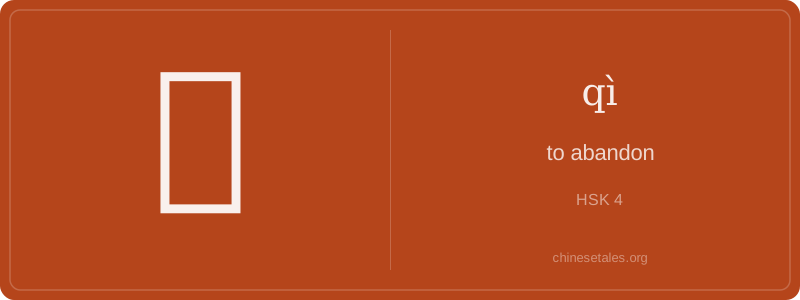
The earliest form of 弃 appears in oracle bone inscriptions as a striking pictograph: a kneeling person (, later simplified to 廾) holding a baby () over a trash pit or basin (廾 + 卩 + 木-like base). Archaeologists interpret this as the ancient practice of infant exposure — a grim ritual of abandonment, often due to poverty or superstition. Over centuries, the baby morphed into the top component 弊 (bì, ‘to conceal’), then further stylized into the modern top part — two horizontal strokes above a slanted ‘X’ shape (), while the lower 廾 (gǒng, ‘hands cupped together’) remained intact, symbolizing the act of *placing down and letting go*.
This visceral origin cemented 弃’s semantic core: not mere disposal, but *ritualized severance*. In the *Book of Documents*, King Wu ‘弃商之旧政’ (qì Shāng zhī jiù zhèng) — ‘abandoned the fallen Shang dynasty’s old policies’ — framing political rupture as sacred release. The character’s structure still whispers its history: the upper part resembles a swaddled infant being lowered, while the lower 廾 — hands held open and empty — embodies surrender, not force. No wonder it appears in classics like the *Analects* only in moments of profound ethical turning points.
Think of 弃 (qì) as Chinese’s version of the ‘delete key’ — but with emotional heft. It doesn’t just mean ‘to discard’ like tossing a coffee cup; it implies *intentional, often irreversible relinquishment*: abandoning a child, quitting a lifelong dream, or renouncing a title. Unlike English ‘abandon’, which can be passive (‘the building was abandoned’), 弃 is almost always volitional and carries moral weight — you *choose* to walk away, sometimes at great cost.
Grammatically, 弃 is a transitive verb that usually takes a direct object without particles: you say ‘弃+object’ (e.g., 弃权 ‘relinquish voting rights’), not ‘弃了’ unless emphasizing completion in narrative contexts. Learners often wrongly insert 了 or use it reflexively (‘弃自己’), but native speakers say 自弃 (zìqì, ‘to abandon oneself’) — a fixed compound. Also, 弃 rarely stands alone in speech; it thrives in formal, literary, or bureaucratic compounds like 弃暗投明 (qì àn tóu míng, ‘abandon darkness, embrace light’ — i.e., defect to the righteous side).
Culturally, 弃 evokes classical resonance: Mencius tells of Emperor Shun, whose father tried to *kill him*, yet Shun never abandoned filial duty — a powerful counterpoint to the word’s gravity. Modern learners mistakenly equate it with casual ‘give up’ (as in ‘I give up on math’); for that, 放弃 (fàngqì) is safer and more neutral. Using 弃 there sounds like you’re staging a dynastic abdication — dramatic, but wildly inappropriate for homework.