森
Character Story & Explanation
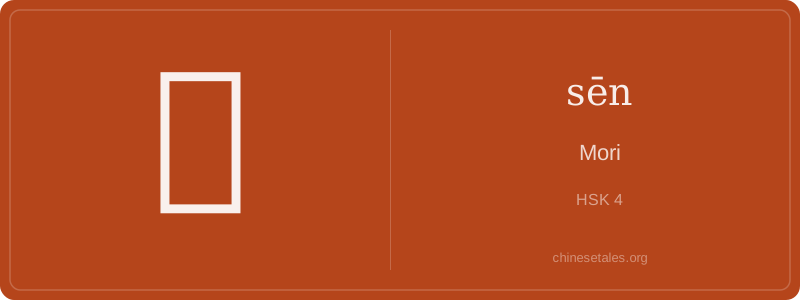
The earliest form of 森 appears in bronze inscriptions as three distinct, stylized 木 (tree) glyphs stacked vertically — no shared trunk, no simplification, just three independent trees drawn side-by-side to convey abundance. Over centuries, the top two 木 gradually fused at their bases while retaining full branches and roots, evolving into the modern structure: one 木 on top, and a double-wood (林) below — making it literally ‘tree + forest’. This wasn’t random simplification; it was semantic layering: the top tree oversees, the lower forest teems beneath — a visual hierarchy of growth and scale.
This triple-tree motif appears as early as the Shuōwén Jiězì (121 CE), where Xu Shen defines 森 as ‘many trees’ (眾多之木), linking its form directly to collective vitality. In Tang dynasty poetry, 森 shifted from pure description to emotional resonance — Du Fu used 森森 (sēnsēn) to describe the ‘dense, shadowy stillness’ of abandoned palaces, where the repetition of the character mirrored the echo of emptiness. The stroke count (12) isn’t arbitrary: each 木 contributes four strokes (一丨丿丶), and three × four = twelve — a rare case where the math *is* the meaning.
At its heart, 森 (sēn) isn’t just ‘forest’ — it’s *dense, layered, almost overwhelming greenness*. Think of stepping into an old-growth woodland where light filters weakly through overlapping canopies: that visceral sense of multiplicity and depth is baked into the character. It’s not a generic ‘wood’ (木) or even ‘tree’ (树), but the *collective, immersive presence* of many trees — so dense they seem to breathe together. That’s why it rarely stands alone as a noun in modern speech; you’ll almost always see it in compounds like 森林 (sēnlín, ‘forest’) or 森严 (sēnyán, ‘strict, austere’ — literally ‘dense + strict’, evoking impenetrable order).
Grammatically, 森 is almost never used by itself as a standalone noun in everyday speech — a common learner mistake. Saying *‘I walked in 森’* sounds unnatural and archaic. Instead, it functions powerfully in compound nouns (森林, 森然) or as an adjective-like intensifier meaning ‘dense, thick, imposing’ — especially in literary or formal contexts: 森然耸立 (sēnrán sǒnglì, ‘tower imposingly’), where 森然 conveys awe-inspiring density and height. Its tone (sēn, first tone) also subtly echoes its meaning: steady, unbroken, like tree trunks rising in unison.
Culturally, 森 carries quiet gravitas — it appears in classical poetry to evoke solitude, antiquity, or spiritual stillness (e.g., Wang Wei’s lines about ‘deep forests’ echoing with temple bells). Learners often misread it as ‘three trees’ and assume it’s colloquial or redundant — but its power lies precisely in that repetition: three 木 radicals aren’t excess; they’re emphasis, rhythm, and ancient visual logic made linguistic.