棵
Character Story & Explanation
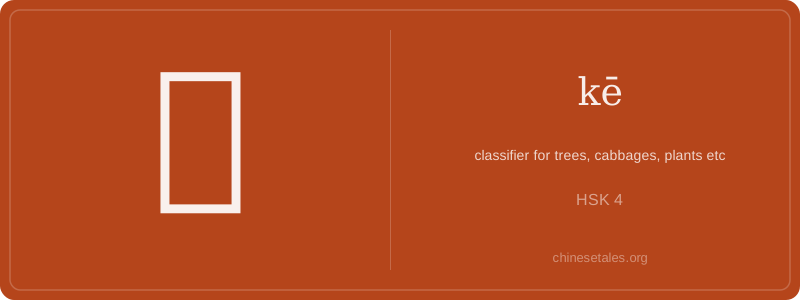
The earliest form of 棵 appears in Han dynasty clerical script, not oracle bones — because it’s a relatively late semantic-phonetic compound. Its left side 木 (mù, ‘tree’) anchors meaning, while the right side 苛 (kē, originally ‘harsh’, ‘exacting’) provides sound. But here’s the visual magic: 苛 itself evolved from 艸 (cǎo, grass) + 可 (kě, ‘can’/‘may’), and in early forms, the top looked like tangled stems — mirroring how a tree’s crown spreads upward. Over centuries, strokes simplified: the grass radical became 艹, then fused into 苛’s top, while 木 stayed firm and upright. By the Tang, 棵 had stabilized into today’s 12-stroke form — a tree (木) standing beside something precise and countable (苛), embodying the idea of ‘a single, definable plant unit’.
This meaning crystallized during the Ming-Qing period, when agricultural manuals began standardizing classifiers. Before then, 棵 was rare; classical texts preferred 本 (běn, ‘root’) or 株 (zhū, ‘stump’) for plants. But as vernacular fiction flourished — think *Dream of the Red Chamber* — writers needed a neutral, widely understood word for ‘one tree’ in everyday speech. 棵 filled that gap: phonetically accessible (kē rhymes with ‘duh’ but sounds crisp), visually grounded in 木, and semantically distinct from abstract or collective terms. Its rise mirrors China’s shift from elite literary language to spoken precision — where every plant deserved its own counted identity.
Imagine you’re walking through a Beijing courtyard in spring — cherry blossoms drift down, and an elderly neighbor points to three slender trees near the gate, saying, 'Zhè sān kē yīngtáo shù kāihuā le!' (These three cherry trees have bloomed!). Notice how she doesn’t say ‘three trees’ — she says ‘three *kē* trees’. That’s 棵: not just a dry grammar rule, but a living, rooted classifier that treats each plant as an individual entity with trunk, branches, and presence — like counting people, not grains of rice. It’s used exclusively for upright, woody or sturdy plants: trees, bamboo, cabbage, corn, even young saplings — but never grass, flowers (use 朵), or vines (use 株 for some shrubs). You’ll sound instantly more native if you swap generic 个 for 棵 when describing anything that stands tall and singular.
Grammatically, 棵 always follows a number or demonstrative (这、那) and precedes the noun: yī kē shù (one tree), nà liǎng kē báicài (those two cabbages). Crucially, it cannot stand alone — no ‘I want three棵’ — and never modifies abstract nouns. A classic learner mistake is overgeneralizing: saying ‘yī kē huā’ (wrong — use 朵) or ‘yī kē mǐ’ (absurd — rice uses 粒). Also, don’t confuse it with measure words for animals (只) or vehicles (辆); 棵 is strictly botanical and vertical.
Culturally, 棵 subtly reflects Chinese agrarian reverence for rootedness and resilience — each ‘kē’ implies a life with roots, history, and growth potential. In literature, it appears in idiom-like phrases like ‘yī kē xīnwàng’ (a seed of hope), borrowing its concrete weight to express something tender yet enduring. And yes — even though it’s HSK 4, native speakers sometimes pause mid-sentence to confirm: ‘Shì yī kē hái yī zhū?’ (Is it one kē or one zhū?) — because choosing the right plant classifier signals deep linguistic intuition, not just vocabulary recall.