标
Character Story & Explanation
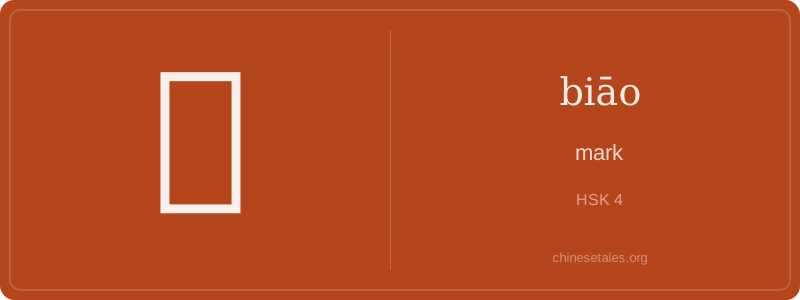
The earliest form of 标 appears in bronze inscriptions as a pictograph: a tall vertical line (丨) representing a wooden stake, topped by a horizontal stroke (一) — the visible tip — and flanked by two curved lines suggesting wind-blown banners or ribbons tied to it. Over time, the banner evolved into the top component 彡 (shān, 'ornamental strokes'), while the stake became 木 (mù, 'tree/wood'), anchoring the character literally and semantically in timber. By the Han dynasty seal script, the shape stabilized: 木 on the left, 彡 on the right — nine clean strokes capturing a standing post adorned for visibility.
This visual logic shaped its meaning: from a literal boundary stake in feudal fields (as in the *Zuo Zhuan*, where '立标以界' meant 'erect a marker to define territory') to abstract standards in philosophy — Mencius used 标 to describe moral exemplars ('a standard for humanity'). The 彡 component is key: it signals *attention-grabbing intent*, not passive presence. That’s why 标 never means 'trace' or 'scar'; it’s always *designed to be seen*. Even in modern tech slang, '打标' (dǎ biāo) means 'to tag data' — still rooted in the idea of attaching a visible, functional label to something otherwise indistinct.
Imagine you’re at a bustling Beijing subway station: every platform has bright red 'EXIT' signs, ticket machines flash 'SCAN HERE', and your phone pings with a notification saying 'New message — tap to view!'. That little word flashing on screens, painted on walls, embedded in apps? It’s 标 — not just a generic 'mark', but a *functional signal*: something deliberately placed to guide, label, or trigger action. In Chinese, 标 carries urgency and intention — it’s never accidental. A '标' is always *put there on purpose*, whether it’s a safety sign (安全标), a price tag (价格标), or a goal (目标). It implies human agency: someone chose this spot, this form, this meaning.
Grammatically, 标 rarely stands alone. It’s almost always part of a compound noun (like 路标, 标准, 标题) or appears after verbs like 设 (shè, 'to set') or 打 (dǎ, 'to make'): 我们在地图上标出了酒店位置 (wǒ men zài dì tú shàng biāo chū le jiǔ diàn wèi zhì — 'We marked the hotel’s location on the map'). Note: You wouldn’t say *'biāo yí gè diǎn'* ('mark a point') without a verb like 出 or 上 — learners often omit the directional complement and sound unnatural.
Culturally, 标 is deeply tied to precision and shared understanding. In exams, teachers '标出重点' (biāo chū zhòng diǎn — 'mark the key points'), turning vague content into actionable knowledge. Confusing it with vague terms like 记 (jì, 'to record') or 印 (yìn, 'to imprint') is common — but 标 isn’t about memory or texture; it’s about *orientation*. And yes — that ‘wood’ radical (木) isn’t random: ancient markers *were* wooden stakes driven into earth. Even today, 'setting a marker' feels physical, grounded, and unmistakable.