桥
Character Story & Explanation
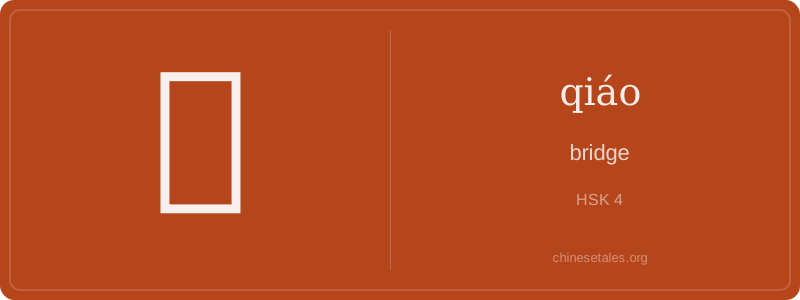
The earliest form of 桥 appears in bronze inscriptions from the Western Zhou dynasty (c. 1046–771 BCE) as a pictograph showing two upright posts (representing piers or abutments) with horizontal planks suspended between them—clearly evoking a simple wooden span over water. Over centuries, the character simplified: the top became 木 (wood), reflecting its original material, while the bottom evolved from a stylized depiction of interlocking beams into the phonetic component 乔 (qiáo), which also means ‘tall’ or ‘lofty’—hinting at the soaring arches of later stone bridges. By the Han dynasty, the modern 10-stroke structure was fixed: 木 on the left, 乔 on the right, merging meaning and sound seamlessly.
This visual evolution mirrors China’s engineering ambition: early bridges were humble timber affairs, but by the Sui dynasty (581–618 CE), the world’s oldest open-spandrel stone arch bridge—the Zhaozhou Bridge—was built, inspiring poets and officials alike. The character 桥 appears in the Tang poet Du Fu’s line ‘qiáo biān hóng yào’, evoking a bridge-side red peony—where the bridge frames memory and passage. Even today, the ‘wood + tall’ structure quietly reminds us that every bridge begins with grounded material (wood) but reaches toward something higher (乔), embodying both practicality and aspiration.
At its heart, 桥 (qiáo) isn’t just a physical structure—it’s a cultural verb for connection: between people, ideas, generations, or even countries. In Chinese thought, a bridge isn’t passive infrastructure; it’s intentional mediation—hence why we say ‘build bridges’ (jiàn qiáo) not just ‘cross bridges’. You’ll hear it in diplomacy (zhōng měi jiàn qiáo), business (shāng yè qiáo liáng), and even romance (ài qíng de qiáo liáng). Unlike English, where ‘bridge’ can be metaphorical but often literal, 桥 almost *always* carries relational weight—even when describing an actual span.
Grammatically, 桥 is a noun that rarely stands alone. It usually appears in compounds (e.g., lì jiāo qiáo, tiān qiáo) or with measure words like yī zuò (a structure), never yī gè. Learners often wrongly use yī gè qiáo—this sounds jarringly unidiomatic, like saying ‘a piece of mountain’ in English. Also, 桥 is never used as a verb on its own (unlike ‘to bridge’ in English); instead, you need verbs like jiàn (to build), jiā (to add), or dā (to erect) before it.
Culturally, bridges are deeply symbolic: in classical gardens, zigzag bridges over ponds weren’t just aesthetic—they were designed to slow movement and ward off evil spirits (who travel only in straight lines). Modern usage reflects this too: ‘cultural bridge’ (wén huà zhī qiáo) implies active, respectful translation—not just transmission. A common mistake? Confusing 桥 with other ‘wood’-radical characters like 板 (bǎn, plank) or 林 (lín, grove)—but 桥’s unique ‘jiāo’ sound and its two-part structure (wood + ‘jiao’ phonetic) make it distinct once you know the pattern.