此
Character Story & Explanation
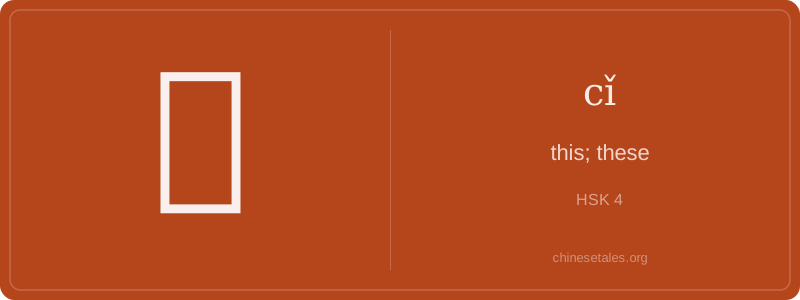
Trace 此 back to oracle bone script (c. 1200 BCE), and you’ll find a simple yet clever pictograph: a foot (止, zhǐ — the radical we still see today) stepping *onto* a marked spot — sometimes drawn as a small square or cross — symbolizing 'here, right at this place'. That foot wasn’t just walking; it was *anchoring*. Over centuries, the 'spot' evolved into the upper component — which looks like 匕 (bǐ), but is actually a stylized marker, not the character 匕 itself. By the seal script era, the foot (止) had settled firmly at the bottom, while the top became more angular, eventually crystallizing into today’s 此 with its clean six strokes: two horizontal lines, a short diagonal, then the unmistakable 止.
This 'foot-on-spot' image didn’t just mean 'here' spatially — it extended to 'this moment', 'this matter', 'this person': anything immediately present and contextually salient. In the Analects and Mencius, 此 appears dozens of times to point to ideas just stated — like a philosophical finger tap: 'This — the virtue we just discussed — is what matters.' Its visual stability (a grounded foot + clear marker) mirrors its semantic role: a linguistic anchor in argument and narrative. Even today, when writers use 此, they’re subtly invoking that ancient gesture — pointing down, planting meaning firmly in shared reality.
At its core, 此 (cǐ) is the elegant, slightly formal cousin of 这 (zhè) — both mean 'this', but 此 feels like wearing a silk robe to a tea ceremony, while 这 is your comfy hoodie at the noodle shop. It’s rarely used alone in speech; instead, it glides into compound words (such as 此刻 or 此地) or appears in written Chinese, classical allusions, and formal announcements — think university notices, legal documents, or poetic lines. You’ll almost never hear someone say *'cǐ shì wǒ de shū'* in daily chat; they’ll say *'zhè shì wǒ de shū'*. But in writing? 此 shines: it’s concise, timeless, and carries gravitas.
Grammatically, 此 functions as a demonstrative pronoun or adjective — always modifying a noun or standing in for one. Crucially, it’s *not* followed by 的 in standard usage (unlike 这). So you say 此人 (cǐ rén, 'this person'), not 此的人. Learners often overuse it trying to sound 'more Chinese', resulting in awkward, unnatural sentences — like sprinkling truffle oil on instant ramen. Also, it’s strictly proximal ('here/this'), never distal ('that/those'); for 'that', you need 彼 (bǐ) or 那 (nà).
Culturally, 此 anchors many idioms and classical phrases — it’s the 'this' in Confucius’ famous line: '己所不欲,勿施于人' (Don’t impose on others what you don’t desire for yourself), where 此 implicitly underlies the logic of 'this principle'. A common trap? Misplacing it in time expressions: 此刻 means 'right now', but 此时 sounds stilted without context — prefer 现在 unless quoting literature or drafting a press release.