死
Character Story & Explanation
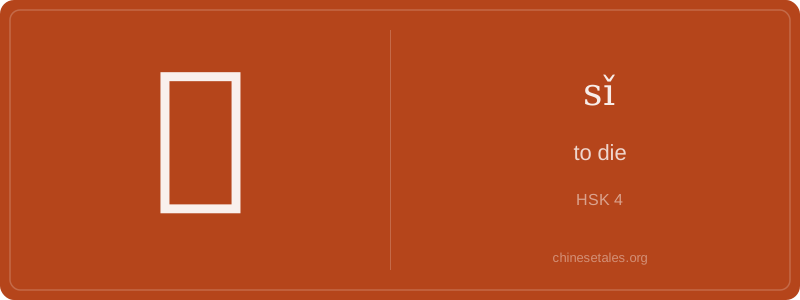
The earliest form of 死 appears on Shang dynasty oracle bones as a composite pictograph: a skull-like shape (the top part, later evolving into + 一) combined with a bent human figure lying prone — sometimes with a slash or dot suggesting lifelessness. By the Zhou bronze script, this simplified into a clear ‘person’ (人, rén) lying beside a skeletal bone (the radical 歹), emphasizing death as bodily cessation. Over centuries, the ‘person’ morphed into the modern 匕 (bǐ) — a stylized, fallen figure — while the bone became 歹, now always placed leftmost as the semantic anchor. The six strokes you write today — 一 丿 乚 丶 丿 ㇏ — encode that ancient stillness: a horizontal line (ground), a falling stroke (collapse), a curved hook (body slumped), then three marks sealing the end.
This visual logic persisted into classical texts: in the Analects, Confucius says ‘未知生,焉知死?’ (wèi zhī shēng, yān zhī sǐ? — ‘Not knowing life, how can one know death?’), treating 死 as the ultimate philosophical boundary. The character’s unflinching clarity — no soft edges, no ambiguity — mirrors its role in Chinese thought: not a transition, but a terminus. Even today, when writers use 死 for emphasis (e.g., 饿死, è sǐ — ‘starve to death’), they’re tapping into that primal, irreversible image — the body on the ground, the bone exposed.
At its core, 死 (sǐ) isn’t just a clinical ‘to die’ — it’s visceral, final, and culturally charged. In Chinese, death is rarely abstract: 死 carries weight, urgency, and sometimes dark humor. You’ll hear it in expressions like ‘累死啦!’ (lèi sǐ la! — ‘I’m *dead* tired!’), where it functions as an intensifier — not literal death, but extreme exhaustion. Grammatically, 死 is a verb that can be reduplicated (死死地, sǐ sǐ de — ‘dead-fast’, meaning ‘gripping tightly’) or paired with aspect particles (死了, sǐ le — ‘has died’). Crucially, it’s almost never used alone in polite speech to refer to someone’s passing — instead, euphemisms like 过世 (guòshì) or 去世 (qùshì) are preferred.
Learners often mistakenly use 死 as a direct translation of English ‘die’ in formal contexts — saying ‘他死了’ (tā sǐ le) about a recently deceased person may sound blunt or even disrespectful in family settings. Also, don’t confuse it with the adjective 死 (sǐ) meaning ‘stale’, ‘dead’ (as in 死水, sǐ shuǐ — ‘stagnant water’) — same character, different semantic flavor, same pronunciation. This polysemy reflects how deeply embedded the concept is in both physical and metaphorical realms.
Culturally, 死 appears in classical idioms like 死而后已 (sǐ ér hòu yǐ — ‘only stop after death’), echoing Confucian devotion. Its radical 歹 (dǎi), meaning ‘unlucky’ or ‘death-related’, appears in all characters tied to mortality or misfortune — like 残 (cán, ‘cruel’), 殃 (yāng, ‘calamity’), and 殒 (yǔn, ‘to perish’). That radical itself is a grim fossil: a stylized bone with a crack, whispering of ancient burial rites.