母
Character Story & Explanation
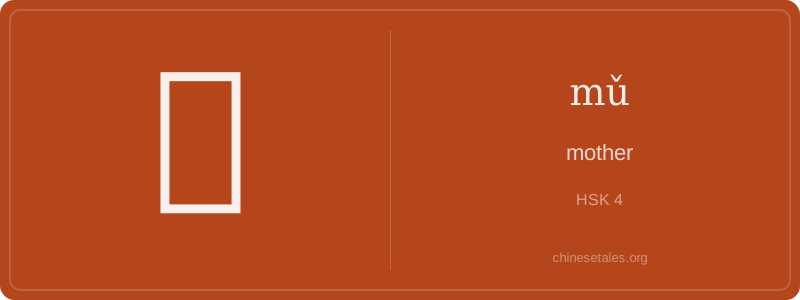
The earliest form of 母 appears in oracle bone inscriptions (c. 1200 BCE) as a stylized woman with exaggerated breasts — two dots or short horizontal strokes — and a rounded torso, sometimes with arms tucked. The five strokes we write today crystallized during the seal script era: the top dot (丶) represents a breast, the two horizontal strokes (一 一) are the other breast and belly line, and the curved 'legs' (乚) suggest a seated or kneeling posture — evoking nurturing stillness rather than movement. Over centuries, the shape simplified, but those two breast-dots remained non-negotiable identifiers.
This visual fidelity to lactation and embodiment persisted in classical usage: in the Book of Rites, 母 specifically denoted the birth mother, distinguishing her from stepmothers (继母) or adoptive mothers (养母). Confucian texts emphasized 母’s moral weight — filial piety (孝) begins with reverence for 母 — yet paradoxically, the character itself stayed starkly physical, refusing abstraction. Even today, its unadorned form — no decorative radicals, no phonetic component — mirrors how Chinese culture treats motherhood: foundational, self-evident, and quietly monumental.
At its heart, 母 (mǔ) isn’t just a word for 'mother' — it’s a cultural anchor. Unlike English’s single-word 'mother', 母 carries warmth, authority, and biological specificity; it’s the default term in formal contexts, official documents, and compound words (like 母语 'mother tongue'), but rarely used alone as a direct address — native speakers usually say 妈妈 (māma) or 妈 (mā) when speaking *to* their mother. That’s key: 母 is more conceptual than conversational.
Grammatically, 母 shines in compounds and abstract roles. It functions as a noun root (e.g., 母亲 'mother'), a classifier-like prefix in technical terms (母舰 'mother ship', 母公司 'parent company'), and even as an adjective meaning 'originating from' or 'source' (母语, 母体 'womb/prototype'). You’ll never see it with aspect particles like 了 or 过 — it resists verbalization because it’s inherently static and relational, not action-oriented.
Culturally, learners often overuse 母 as a standalone term of address ('Mǔ!'), which sounds stiff or even clinical — like calling your mom 'Parental Unit'. Another trap: confusing 母 with 女 (nǚ, 'woman') or 毋 (wú, 'do not'), especially in handwriting. And remember — while 母 always implies biological or foundational origin, it doesn’t imply affection; that emotional layer comes only through context or paired terms like 亲爱的母亲.