洲
Character Story & Explanation
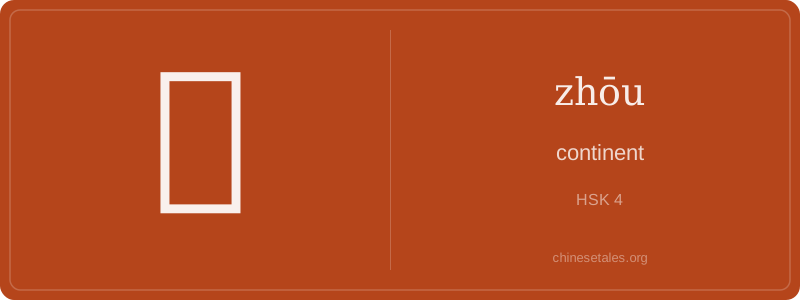
The earliest form of 洲 appears in bronze inscriptions as ⿰水州 — three wavy lines (氵, water) beside a simplified pictograph of a flat, elevated area with a central ridge (州). That original 丶 + 三 + 丶 shape represented *alluvial islands* — strips of fertile land formed by river sediment, clearly visible in the Yellow and Yangtze Rivers. Over centuries, the three ‘island segments’ condensed into three dots above a horizontal line (the modern 州 component), while the water radical solidified as 氵 on the left — preserving the essential idea: land born of water.
This origin directly shaped its meaning: in the Classic of Poetry (Shījīng), 洲 refers to riverine sandbars where reeds grew and lovers met — places of shelter and transition. By the Han dynasty, Buddhist translators adopted 洲 to render Sanskrit ‘dvīpa’ (island-continent), expanding it to cosmic continents like 南贍部洲 (Nán Shànbù Zhōu, ‘Jambudvīpa’ — our world). The visual logic remained constant: not just land, but *land defined by its relationship to water* — a subtle, enduring ecological insight baked into the strokes.
At first glance, 洲 (zhōu) means 'continent' — but that’s just the tip of the iceberg. In Chinese, it carries a quiet, grounded majesty: not just vast landmasses, but land *emerging from water*, stable and life-sustaining. You’ll rarely hear it used alone in speech — it almost always appears in compounds like 亚洲 (Yàzhōu, Asia) or 欧洲 (Ōuzhōu, Europe). Unlike English ‘continent’, which implies geopolitical scale, 洲 subtly emphasizes *geographic emergence* — a poetic echo of how ancient Chinese saw land as islands rising from rivers and seas.
Grammatically, 洲 is strictly a noun and never functions as a verb or adjective. Learners sometimes mistakenly use it like English ‘land’ (e.g., *‘my land’ → *我的洲), but that’s unnatural — native speakers say 我的土地 (wǒ de tǔdì) or simply 我的家乡 (wǒ de jiāxiāng). Also, 洲 never means ‘island’ (that’s 岛 dǎo); confusing them leads to comical errors like calling Hawaii ‘Hawaiian Continent’ instead of ‘Hawaiian Islands’.
Culturally, 洲 reflects China’s historical worldview: the known world was centered on Zhōngguó (‘Central State’), surrounded by four great ‘continents’ — a cosmological framework from Buddhist geography (like the Four Continents surrounding Mount Sumeru). Today, it’s neutral and scientific — yet still tinged with classical resonance. A common mistake? Overgeneralizing: while North America is 北美洲 (Běi Měizhōu), you’d never say *‘Shanghai is in Shanghai洲’ — it only names *major, globally recognized* continental divisions.