活
Character Story & Explanation
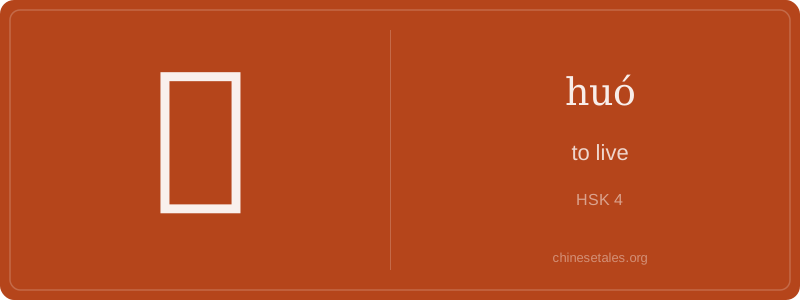
The earliest form of 活 appears in Warring States bamboo slips as a combination of 水 (water) and 逎 (a phonetic component meaning ‘to go forth’ or ‘to seek’). Oracle bone script didn’t feature 活 directly, but bronze inscriptions show early variants with three water dots (氵) plus a simplified 逎 — a flowing path under water, perhaps symbolizing life emerging from primordial waters or rivers sustaining existence. Over centuries, 逎 gradually stylized into the modern 话’s right-hand side (but without the 言), becoming — a compact shape with a horizontal stroke, a bent line, and a final dot-like stroke, preserving the sense of directed motion amid fluidity.
This visual logic shaped its semantic journey: from concrete ‘flowing water sustains life’ → abstract ‘to be alive’ → extended meanings like ‘lively’, ‘practical’, and even ‘to make work’ (as in 活动). By the Han dynasty, 活 appears in the *Shuōwén Jiězì* dictionary defined as ‘to survive, to endure’, already carrying moral resonance — Mencius wrote ‘生,亦我所欲也;义,亦我所欲也。二者不可得兼,舍生而取义者也’ — implicitly framing 活 as the baseline condition from which ethical choice arises. The water radical never faded; it’s a constant reminder that life, like water, must move to remain vital.
At its heart, 活 (huó) isn’t just ‘to live’ — it’s *aliveness in motion*: breath, pulse, resilience, and unscripted human presence. The water radical 氵 on the left whispers liquidity and flow; the right side, (a variant of 逎, historically linked to ‘to seek’ or ‘to go forth’), suggests forward movement — together, they evoke life as a dynamic, flowing force, not a static state. This is why 活 feels warm and embodied: you don’t just ‘exist’ with 活 — you *thrive*, *survive against odds*, or *keep going*.
Grammatically, 活 shines as both verb and adjective. As a verb, it’s often used in resultative constructions like 活下来 (huó xiàlái — ‘to survive’), where 下来 adds directionality and completion. Learners mistakenly treat it like English ‘live’ and say *wǒ huó zài Běijīng* — but no! For ‘I live in Beijing’, you use 住 (zhù): 我住在北京. 活 here would imply ‘I’m surviving *in* Beijing’ — a very different, almost desperate nuance. Also, note that 活 can’t take aspect markers like 了 directly (*wǒ huóle*) — instead, you say 我活过 (huóguò, ‘I’ve lived [through something]’) for experiential past.
Culturally, 活 carries quiet philosophical weight: Confucius praised the ‘living tradition’ (活的传统), valuing adaptability over rigid orthodoxy. In modern slang, 活 is playful — 活该 (huógāi, ‘serves you right!’) uses the character ironically, twisting ‘aliveness’ into karmic justice. A common trap? Over-translating 活 as ‘alive’ when context demands ‘functional’ (e.g., 这台电脑不活了 — ‘this laptop won’t turn on anymore’ — literally ‘isn’t living’).