烤
Character Story & Explanation
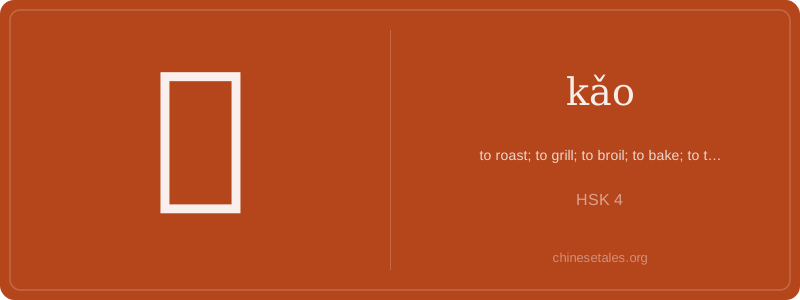
The earliest form of 烤 appears in Han dynasty clerical script, not oracle bones — because roasting over open flames wasn’t written about until cooking techniques became refined enough to distinguish methods. Visually, it’s a brilliant fusion: left side 火 (fire), simplified from the pictograph of flames, and right side 告 (gào), which originally depicted a mouth (口) above a cow’s head (牛), symbolizing ‘to report’ or ‘to proclaim’. In 烤, 告 serves primarily as a phonetic clue (both 烤 and 告 share the -ǎo/-ào rime), but its ‘announcement’ connotation beautifully mirrors how roasting announces itself — through scent, sound, and visible charring.
By the Tang and Song dynasties, 烤 emerged as a distinct term in culinary texts to specify dry-heat preparation, differentiating it from boiling, steaming, or frying. The character’s structure — fire literally *supporting* the act of proclamation — captures the essence: fire doesn’t just cook; it transforms and declares the result. In classical usage, 烤 rarely appeared alone; it was paired with ingredients (e.g., 烤豚 — roasted suckling pig in Song-era gastronomy), reinforcing its role as a precise, intentional verb. Its modern shape froze in the standardization of regular script, preserving that elegant balance: three dots of fire on the left, and the confident, upright 告 on the right — a character that looks like it knows exactly what it’s doing.
At its heart, 烤 is all about controlled fire — not the wild blaze of 火 (huǒ) itself, but the deliberate, sustained heat applied to transform food: roasting meat over coals, grilling skewers on a street stall, or baking buns in a clay oven. Its radical 火 (fire) anchors it in thermal energy, while the right side 告 (gào) isn’t just phonetic — it subtly echoes ‘to announce’ or ‘to declare’, as if the sizzle and aroma *announce* that something delicious is happening. This isn’t passive heating like 煮 (boiling) or 蒸 (steaming); 烤 implies direct, dry heat from below or all around.
Grammatically, 烤 is a transitive verb requiring an object (you roast *something*), and it’s commonly used in both resultative constructions (烤熟 — ‘roast until cooked’) and with aspect particles (烤了, 正在烤). Learners often mistakenly use it for ‘baking’ cakes — fine in casual speech, but purists reserve 烘 (hōng) for oven-baking delicate pastries. Also, don’t confuse it with 烧 (shāo), which is broader (‘to burn’ or ‘to cook’ generally) and lacks 烤’s specific dry-heat nuance.
Culturally, 烤 evokes vibrant scenes: Beijing’s roast duck (北京烤鸭), Xinjiang’s cumin-laced mutton skewers (羊肉串), and winter street vendors roasting sweet potatoes (烤红薯). It’s deeply tied to communal, outdoor, sensory cooking — think smoke, char, and crust. A common slip? Using 烤 for ‘toasting’ bread — acceptable colloquially, but in formal contexts, 烘 toast or 烤面包 both work, while 烤 alone sounds oddly bare (like saying ‘I grill’ instead of ‘I grill chicken’).