无
Character Story & Explanation
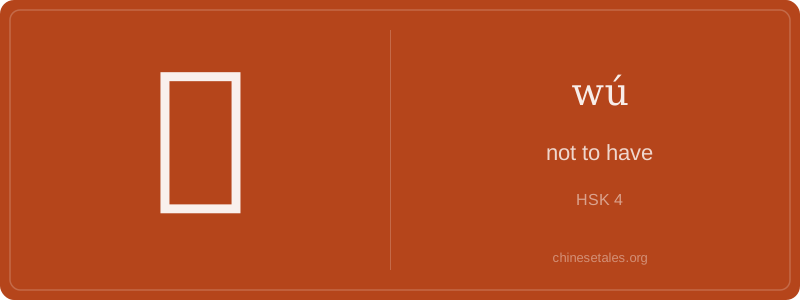
The earliest form of 无 appears in bronze inscriptions as a stylized depiction of a dancing shaman waving two ox-tails — a ritual gesture meant to invoke spirits *or* to symbolically dispel them. Over centuries, those flowing tails simplified into the two diagonal strokes (丿 and ㇏) flanking the central vertical (丨), while the top dot (丶) emerged as a mark of abstraction — turning motion into meaning. By the seal script era, it had crystallized into a balanced, minimalist glyph: three strokes suggesting movement outward, then one dot sealing the void — a visual paradox: *presence defined by absence*.
This ritual origin explains why 无 evolved beyond simple negation. In the Dao De Jing, 无 (wú) and 有 (yǒu, ‘to have’) are paired as cosmic principles — not opposites, but interdependent forces, like yin and yang. Confucius used 无 to express moral lack: 无信不立 (wú xìn bù lì, ‘Without trust, one cannot stand’). Even today, that ancient weight remains: 无 isn’t casual; it’s definitive, almost sacred — the character you choose when stating a fundamental truth about reality.
At its heart, 无 (wú) isn’t just ‘not to have’ — it’s the elegant, almost philosophical negation of existence or possession. Unlike English ‘don’t have’, which feels transactional, 无 carries quiet finality: no trace, no residue, no possibility. It’s the word you’d use for ‘no hope’, ‘no evidence’, or ‘no precedent’ — not just ‘I don’t have cash’. Think of it as the Chinese equivalent of a firm, graceful shrug: not angry, not defensive, just fundamentally *absent*.
Grammatically, 无 is rarely used alone in modern speech — it shines in compounds (like 无所谓 wú suǒ wèi, ‘it doesn’t matter’) or formal writing. Crucially, it *never* replaces 没 (méi) before verbs: you say 没有吃 (méiyǒu chī, ‘haven’t eaten’), never *无吃. But before nouns or in literary/formal contexts? 无 is king: 无风 (wú fēng, ‘windless’), 无价 (wú jià, ‘priceless’). Learners often overuse it trying to sound ‘more Chinese’, ending up sounding like a Ming dynasty scholar at a coffee shop — charming, but confusing.
Culturally, 无 echoes Daoist and Buddhist thought: 无为 (wú wéi, ‘non-action’) doesn’t mean laziness — it means acting without ego-driven force. And watch out for the classic slip: writing 无 instead of 末 (mò, ‘end’) or 午 (wǔ, ‘noon’) — their shapes are deceptively similar. Remember: 无 is *empty*, not *ending* or *midday*.