奖
Character Story & Explanation
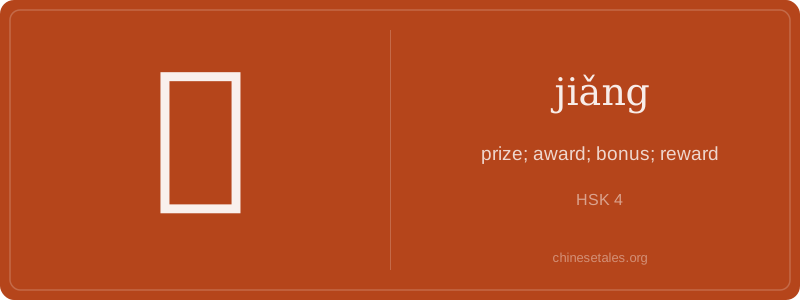
The earliest form of 奖 appears in bronze inscriptions of the Western Zhou dynasty (c. 1046–771 BCE) as a compound pictograph: an upper component resembling 爿 (a split log, later stylized into 将) and a lower 大 (dà — 'big' or 'person'). Scholars believe it originally depicted a person (大) holding up or presenting something valuable — perhaps grain, ritual wine, or a symbolic object — to honor achievement. Over centuries, the top evolved from 爿 into 将 (jiāng), a phonetic component that also carries the sense of 'to lead' or 'to advance', reinforcing the idea of promoting virtue through recognition.
By the Han dynasty, 奖 had solidified its dual role: both 'to reward' and 'prize'. Confucius praised rewarding moral conduct in the Analects (e.g., '善者好之,不善者恶之,是谓奖善惩恶' — though this phrasing is later), and Tang poets used 奖 to describe imperial commendations for loyal service. Crucially, the 大 radical isn’t decorative — it anchors the character in human scale and dignity: every award is given *by* and *to* people. That big, open stance of 大 reminds us: recognition only matters when it’s sincerely offered between humans.
Think of 奖 (jiǎng) as Chinese culture’s cheerful handshake with excellence — it’s not just a 'prize' in the Western trophy sense, but a socially charged token of recognition, often carrying warmth, encouragement, or even gentle pressure to keep improving. The character feels positive and uplifting, never cold or transactional: when your teacher says 你真棒,老师给你发个奖!(Nǐ zhēn bàng, lǎoshī gěi nǐ fā gè jiǎng!), it’s less about winning and more about shared pride.
Grammatically, 奖 is versatile: it can be a noun (e.g., 一等奖 yī děng jiǎng — 'first prize'), a verb meaning 'to reward' (e.g., 老师奖励了他 tā shì jiǎnglì le tā — 'The teacher rewarded him'), or part of compound verbs like 奖励 (jiǎnglì). Watch out — you *cannot* say 我奖你 five yuan; that’s ungrammatical. Instead, use 奖励 or 奖赏. Also, avoid using 奖 alone as a verb without context: 奖他 sounds incomplete, while 奖励他 flows naturally.
Culturally, 奖 reflects China’s emphasis on collective motivation — awards are often given publicly in class or at work to model desirable behavior, not just celebrate individual triumph. Learners sometimes overuse it for small favors (like ‘thanks’), confusing it with 谢谢 or 礼物. Remember: 奖 implies earned merit, not courtesy. And yes — even a gold star sticker on a child’s homework? That’s a 奖.