哪
Character Story & Explanation
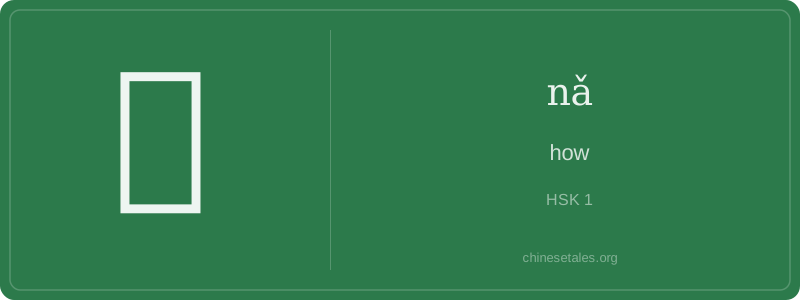
The earliest form of 哪 appears in seal script as a compound: the ‘mouth’ radical 口 on the left (hinting at speech and questioning), and on the right, a stylized version of 亻(person) + 卩 (a kneeling figure or ritual token) — later simplified into the modern ‘na’ sound component 那. Over centuries, the right side evolved from complex bronze-age glyphs representing ‘that person there’ into the streamlined 那 we see today. By the Song dynasty, the character had stabilized into its current nine-stroke shape: three strokes for 口, six for the phonetic 那 — each stroke carefully balanced like a scale tipping toward inquiry.
This visual logic mirrors its semantic journey: originally tied to demonstratives meaning ‘that one there’ (as in classical texts like the Book of Rites), 哪 gradually shifted from pointing outward to probing inward — becoming the go-to character for interrogative selection. Its ‘mouth’ radical anchors it in spoken language, while its phonetic core 那 reminds us it was born from contrast: ‘this’ vs. ‘that’, now refined into ‘which one of these?’. No wonder it feels so essential — it’s literally speech reaching out to choose.
Imagine you’re in a Beijing hutong, holding a steaming bowl of dumplings, and your friend points at three plates — pork, chive, and mushroom — then asks: nǎ gè? (‘which one?’). That little word 哪 isn’t just ‘which’ — it’s the Chinese brain’s built-in question filter, instantly narrowing down *all possible options* into a manageable set. It never stands alone; it always teams up with measure words (gè, lǐ, tiān) or nouns to ask ‘which X?’, ‘where?’, or even ‘how?’ in rhetorical exclamations like nǎ lǐ shì yìsi? (‘where’s the sense in that?!’).
Grammatically, 哪 is a question pronoun that *requires* context — it can’t mean ‘what’ or ‘who’ by itself. You’ll say nǎ ge rén? (‘which person?’), not just nǎ?. And crucially: it only appears in questions — never statements or commands. A common mistake? Using it like English ‘how’ in isolation: learners say nǎ hǎo? thinking it means ‘how are you?’, but the correct phrase is nǐ hǎo ma? — because 哪 doesn’t mean ‘how’ on its own; it’s about *selection*, not manner.
Culturally, 哪 carries subtle warmth — it invites participation. In Mandarin, asking nǎ lǐ? (‘where?’) feels more open and collaborative than a blunt command. And yes — there’s that rare něi pronunciation! In some northern dialects and poetic contexts (like classical lines such as něi biān de shān, ‘that mountain over there’), it softens to něi, but for HSK 1, stick firmly with nǎ — and remember: it’s always hunting for *a specific choice*, never floating abstractly.