商
Character Story & Explanation
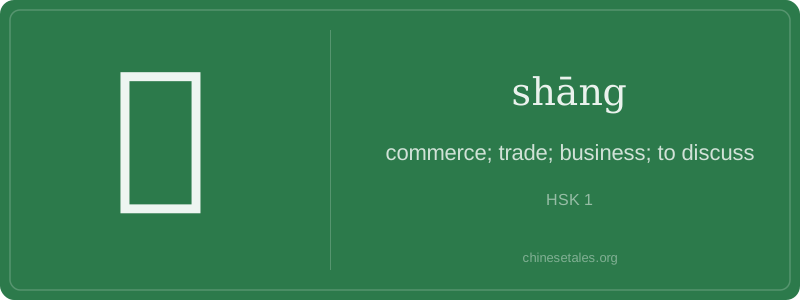
The earliest form of 商 appears on Shang dynasty oracle bones (c. 1200 BCE) as a complex pictograph: a stylized representation of a ritual bronze vessel called a 'shāng zūn', used in ancestral ceremonies. This vessel had a distinct wide mouth, flared rim, and ornate handles — elements echoed in the modern character’s top (亠 + 丷 + 口-like frame) and lower 口 radical. Over centuries, the intricate vessel design simplified: the decorative motifs became the angular strokes above 口, while the vessel’s open mouth solidified into the clear 口 at the bottom — anchoring the idea of vocal exchange.
From ritual vessel → symbol of the Shang dynasty (whose name shares the same pronunciation and character) → metonym for the dynasty’s administrative and mercantile practices. By the Warring States period, 商 had shifted from 'ritual object' to 'trade' — because the Shang were famed merchants, and their name became synonymous with commerce itself. Classical texts like the *Zuo Zhuan* use 商 to denote marketplaces and commercial agreements, and by the Han dynasty, it also meant 'to deliberate', linking speech (口) with strategic exchange — a semantic leap rooted in how business was done: face-to-face, voice-to-voice, deal-by-deal.
At its heart, 商 feels like a bustling marketplace crossed with a conference room — it’s the Chinese word for both 'commerce' and 'to discuss', two ideas that historically went hand-in-hand: trade required negotiation, and negotiation was commerce in motion. The character radiates pragmatic energy — not abstract theory, but real people haggling over price, signing contracts, or brainstorming solutions. Its core vibe is collaborative exchange: of goods, ideas, or decisions.
Grammatically, 商 is versatile but rarely stands alone as a verb in modern spoken Mandarin. You’ll almost always see it in compounds (like 商量 or 商业) or as part of formal/noun-based structures. Learners often mistakenly try to say 'I shāng you' for 'I’ll discuss with you' — but no! That’s ungrammatical. Instead, use the compound 商量 (shāng liang), where 商 contributes the 'consultative' root and 量 adds the nuance of 'measuring options together'. Even in HSK 1 contexts, 商 appears in fixed phrases like ‘shāng diǎn’ (shop) — not as a free verb, but as a lexical building block.
Culturally, 商 carries quiet prestige: unlike slangy terms for 'chat', 商 implies seriousness and mutual respect. It’s used in government announcements ('shāng què yì xiàng'), business emails, and even family decisions ('jiā tíng zhōng shāng liang'). A common mistake? Confusing it with 尚 (shàng, 'still/yet') — same sound, totally different meaning and shape. Remember: 商 has 口 (mouth) + a distinctive upper structure — because real business starts with speaking, not just hoping.